Why Your Best Brown Layer's Eggs Turn Pale by Late Summer
A hen's brown eggshell turns pale by late summer because the brown pigment is deposited into the shell in the final few hours before the egg is laid, and a hen that has been laying without a real pause since spring has been spending that pigment every single day. The color thins before the hen does. In most cases there is nothing wrong with her and nothing wrong with the egg; the paleness is a date stamp. Read the shade as a date, and the basket stops being a pile of eggs and becomes a per-bird record — the hen you know by her feathers also becomes a hen you know by her shells.
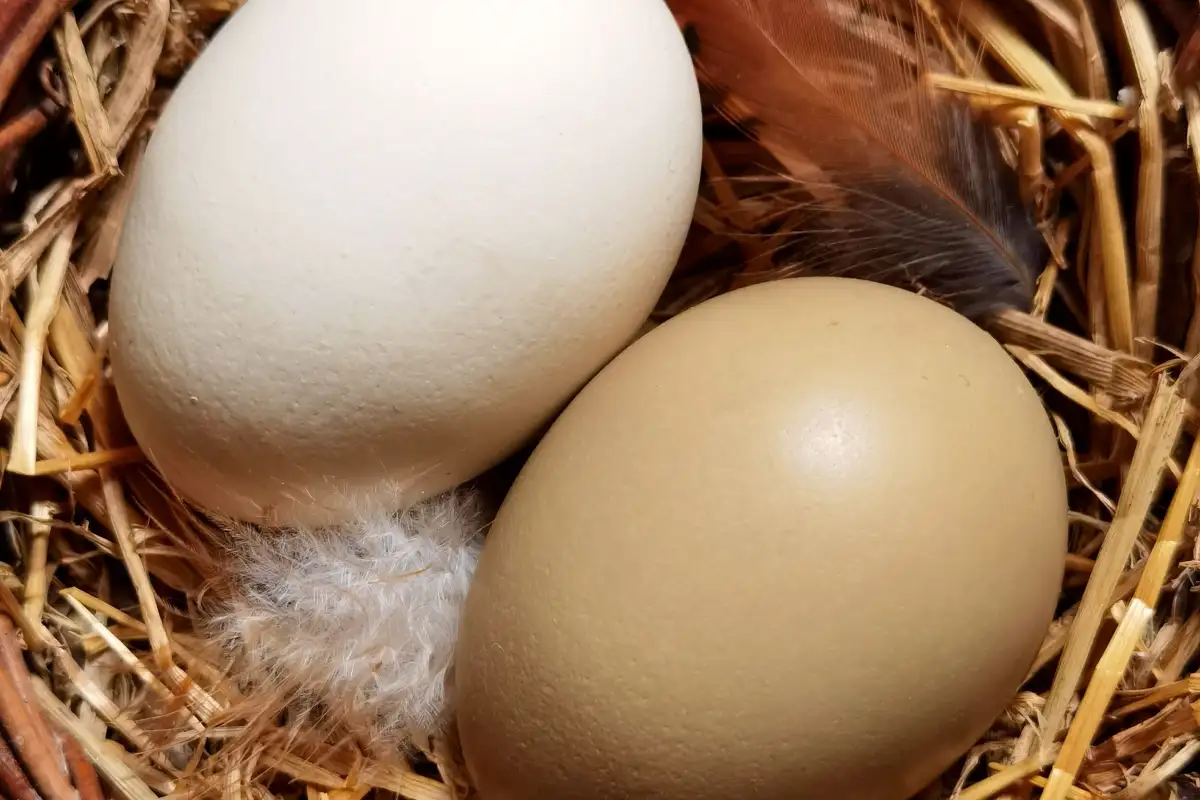
I keep a mixed flock: mostly brown layers, a couple of blue-green layers, and one small white-egg hen who has never once wavered. By mid-August the basket goes soft on me. Eggs that came out deep terracotta in April look like weak tea. Same hens, same run, same water, same everything. The first August that happened I spent a week convinced something was wrong with the flock. It took a second August to see that I had been staring at a calendar and calling it a symptom.
The color goes on last
An eggshell is not painted from the inside out. The shell is built over many hours, but the color — in a brown egg, protoporphyrin IX — is worked into the outer layer in roughly the last few hours before the egg travels out. That timing is the whole story. The color is the newest thing about the egg. Everything else on that shell was decided yesterday morning; the shade was decided today.
So when a hen lays an egg a day for months on end, she is spending pigment on every one of them with no week off to rebuild the supply. The shells come out a little lighter each time, and the fade is gradual enough that you do not notice it until you put an April egg next to an August egg. Then she molts, or simply takes a break, and the pigment has room to rebuild. The first eggs after that pause come out as saturated as anything she laid in spring.
That is also why you cannot judge a hen's color against another hen. Some brown lines simply lay a pale tan egg from their first egg to their last, and a pale tan egg from a pale tan hen is normal. Judge her against her own spring.
What short days have to do with it
Late summer is when two lines cross. The hens have been laying long enough for the color to thin, and the days have started getting short enough that the molt is coming. So late summer is peak pale — maximum cycle, minimum pigment, molt still ahead. Once they drop feathers and take that pause, the reset happens, and the deep color comes back with the first eggs of the next cycle, usually into fall and winter.
Blue and green are a different mechanism
Blue shell color is not a shade of brown. It comes from biliverdin, a pigment that shows up only in hens carrying the blue-egg trait, and that trait is inherited as a dominant one through the blue-egg line — the one that came into backyard flocks through the South American blue-egg breeds and spread widely through the mixed blue-egg crosses sold at feed stores. Green shells are both pigments stacked: a blue base with brown laid over it. Cross a brown layer with a blue-egg hen and you get green layers, because the two pigment systems do not cancel each other out.
White shells have no shell pigment in them at all. That hen is not failing to add color; she simply is not adding any. Which means a white egg never fades the way a brown egg fades across a cycle, and that in itself is a signature. If you have one white-egg hen in a flock of brown layers, she identifies herself every single day.
Blue-green eggs also tend to hold their shade more steadily across a cycle than brown eggs do, because biliverdin is distributed through the shell rather than concentrated in the outer layer. I still see some drift, but it is modest compared to the slope on a brown egg.
Size runs the other way
While color fades across the cycle, size climbs across the hen's life. A pullet's first eggs are small, sometimes comically small, and they get bigger as her body finishes growing and the egg-making machinery stretches out. The same bird a year later is laying a noticeably larger egg. Then it plateaus, and in her later years it may drift back up into the jumbo range.
Put those two directions together and you get a useful cross-read. A small, pale egg in August is a young hen deep into a long first cycle: small because she is young, pale because she has not stopped. A big, deep-colored egg in the same basket is an older hen who has recently come back from a break. Same basket, two completely different stories, and you never had to catch a single bird.
Shape is the fingerprint
Shape is the one trait that barely moves. Set by the bird's own anatomy, it stays with her: long and tapered, round and blunt, slightly asymmetrical at the wide end. Hens that lay a strange shape keep laying that strange shape. So when something odd shows up in the carton, you do not have a mystery — you have a two-day wait. Whoever lays it again owns it.
I had one hen whose eggs were visibly longer than everyone else's, with a more drawn-out point at the narrow end. I could pull hers out of a full basket by feel, in the dark, without looking at color at all. That is the trait I lean on hardest when I am trying to sort out who is doing what.
Speckles, texture, and the rest of the signature
Speckling and surface texture differ between individual hens too. Under a bright overhead light, some hens' eggs come out dusted with darker flecks toward the wide end; others come out absolutely clean. Some shells feel like a stucco wall and some feel like polished porcelain, and those qualities repeat bird to bird. In a mixed flock, a full carton carries a signature line for each hen.
One thing worth knowing before you start comparing: shade shifts with the light you are reading it under. Porch daylight and kitchen overhead make the same egg look like two different eggs. I pick one spot and do all my comparing there, or the whole exercise falls apart.
Double yolks belong to the beginners
A double-yolk egg is two yolks released in the same cycle, with one shell built around both of them. It shows up most often in pullets that have just started laying, because their cycles are still sloppy, and it usually tapers off as things regularize. It is not a defect and it is not a sign of anything you need to fix. It is a note that this particular bird's timing has not settled yet, and it is almost always a young hen's signature rather than an older one's.
How I actually use this
My method is unglamorous. I pick one hen, or one shape I am curious about, and I look at three eggs from three consecutive days. I note the shade, the size, the shape, and whether there is any speckle. Then I do nothing for three weeks and look again. Then I do it once more after the molt, when the colors snap back.
Three readings teach me the bird. After that, the basket answers questions I would otherwise have to answer by standing in the run at dusk counting heads:
- Who is still laying, and who has quietly stopped. The absence of a hen's shape in the carton shows up before anything else does.
- Whether a slowdown is a real change or just the normal slope of a long cycle. If her last three eggs are pale but her shape is consistent, she is fine and tired.
- Which bird owns the odd egg, so a quirk stays a quirk instead of becoming a worry.
There are cases where the reading gets noisy. A hen laying two eggs in a day, or skipping days and restarting, blurs the shade pattern badly, and I stop trusting the basket for that bird until she settles. And the fade is not a diagnosis of anything in particular — it is a measure of how long she has been at it without stopping. If a hen goes pale and then goes pale again after a break, that is worth a second look for reasons that have nothing to do with shell color.
But for the ordinary late-summer basket, the ordinary answer holds. The hen is not failing. She is just running long, and the shell is telling you exactly how long, in a shade you can see without ever touching her.