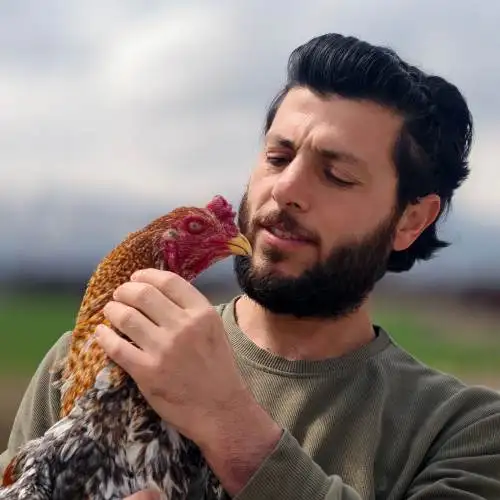
Every Heritage Dual-Purpose Breed Was Made for a Specific Farm Problem
Every heritage dual-purpose breed was built to solve one farm's particular problem, and the old breed descriptions are work orders rather than nostalgia: a comb shaped so it will not freeze, a body that can lay through a northern winter and still dress out heavy in the fall. Match each breed against the problem it was written for and the list stops looking like a row of interchangeable brown chickens. It starts looking like a map of climate, market, and kitchen. The category thinned out after the 1940s not because the birds got worse, but because the problem they answered got cut in half.
I do this reading every February, at about six in the morning, standing in the coop doorway with a bucket of water that will be a block of ice before I am done with chores. The latch bites through the glove. Inside, the air is warmer than outside by maybe ten degrees and smells like straw and dry feathers.
Watch which hen comes off the roost first. If it is the Buckeye, what you see is a head with almost nothing on it. The comb is a pea comb, low and close to the skull, a row of small bumps rather than a blade. The wattles are so small they barely read as wattles. The feathers lie tight against the body like shingles. Nothing on that bird is standing up to catch frost.
That is not charm, and it is not luck. It is the first line of the breed description, drawn on the bird.
The head, the feet, and the feathers are the record
Start reading bodies instead of names and the list sorts itself.
Comb shape is a climate decision before it is anything else. A tall single comb, the floppy sawtooth kind, is a radiator. That works in a warm climate and it is the first part of a bird to frost in a cold one, which is exactly why the cold-country breeds either shrink the comb or change its shape. A pea comb, a rose comb, and a cushion comb are three different answers to the same question: how do I keep this thing attached to a head that has to be outside all winter?
Feather tightness is the second entry in the record. A hard-feathered bird holds its plumage close and gives weather less to grab. Feet and legs are the third: clean, unfeathered shanks where the ground is wet, and the opposite where it freezes hard and stays that way. Then the frame, and whether it reads like a layer or a table bird.
Nine times out of ten, when a breed description from around 1900 sounds fussy about a comb or a toe count, the fussiness is a climate or a market showing through.
Buckeye and Chantecler are the same problem solved twice
The Buckeye came out of Ohio in the 1890s, bred by Nettie Metcalf. It is the only American breed generally credited to a woman breeder, and there is a specific farm behind the description: a Midwestern winter, a farm kitchen, and a bird that had to be worth feeding through the cold months. Metcalf's answer was a pea comb, tight plumage, and a mahogany-red body that reads dark from across the yard.
The Chantecler was developed in Canada for severe cold, which sounds like the identical brief. It is not quite. The Chantecler's head carries a small cushion comb and almost no wattle at all, sometimes none worth naming. Two breeders working in two countries arrived at the same principle without copying each other: reduce the exposed surface on the head. The Buckeye minimizes with a pea comb. The Chantecler minimizes further, and then minimizes again.
That is the pattern worth seeing. Nobody was breeding for looks first. They were breeding against a specific weather problem, and whatever combination of skin and feather survived that problem is what ended up written into the standard.
The oldest American breeds were answering a farm with no bagged feed
The Dominique is commonly described as the oldest American breed, and you can pick one out by the rose comb and the close barring. The Java goes back to the 1800s and is among the oldest American breeds, kept in black and mottled varieties.
Neither was designed for a show pen. Both were designed for a farm where the flock foraged for a good share of its living, where there was no pallet of bagged feed and no heated building, and where a bird that needed coddling was a bird you ate. A rose comb in that setting is not decoration. It is the same logic as the Buckeye's pea comb, just older and rougher, worked out before anyone was writing it down as a principle.
Delaware was a market problem, not a weather problem
Then you reach the 1940s and a breed that breaks the climate pattern entirely.
The Delaware was developed from a Barred Plymouth Rock and New Hampshire Red cross. Its job was not winter. Its job was the broiler trade: a white-bodied bird that dressed cleanly and carried a shape the market was asking for. For a short stretch it displaced the Barred Plymouth Rock in commercial use, which is a remarkable thing to do to a breed that had effectively defined the American farm chicken for decades before it.
Read the Delaware as a design brief and you can almost date the brief. It is the moment the farm bird starts being asked to serve one customer instead of a household.
Faverolles is the one that does not fit, which is why it is worth keeping
The Faverolles is a French breed with five toes, a beard, and muffs, and a long-standing reputation for a calm, low-key temperament. Stack that against the American cold-weather logic and it looks like noise in the signal.
It is not noise. It is a different problem being solved. The Faverolles came out of a farmyard system where birds lived close to people in mixed pens, and where a quiet bird that did not fight and did not range far was a bird worth feeding. Five toes and a beard keep nothing warm. They are markers from a closed, distinctive local population, the kind of thing that appears when a region breeds to its own taste for a long time without outside stock coming in.
So the rule holds. Name the problem and the odd features explain themselves.
After the 1940s, the middle of the bird stopped paying
Here is what actually happened to the category.
A dual-purpose bird is a hedge. It lays a decent number of eggs and it dresses into a decent carcass. On a mixed farm, that hedge is the whole point. If eggs are cheap in March you eat a bird; if birds are cheap in October you sell eggs; either way you are not ruined by a bad season. A hedged animal is a smart animal on a farm that has to survive variance.
Then production split into two specialized tracks: egg-type layers on one side, fast-growing meat crosses on the other. Neither track needs a hedge, because neither track is a farm. Each is a single-output operation, and a single-output operation wants a bird that is fully good at one thing rather than decent at two.
After the middle of the twentieth century, the dual-purpose breeds were not beaten by bad birds. They were beaten by a change in what a chicken was for. When the structure of production moves, the animals built for the old structure become "general purpose," which in a specialized market is a polite word for obsolete. Most breed write-ups skip that part. They tell you a breed declined and let it sound like a tragedy or a matter of taste, when it was arithmetic.
What this means when you pick a breed now
Name your problem before you name your breed. That is the whole method.
If you are fighting a wet, cold winter with no heat in the coop, you are looking for what Metcalf was looking for, and the old cold-weather breeds are the coherent answer. If your problem is a hawk working the run, you want tight feathering, a medium frame, and an alert bird, which is a different list. If your problem is a small yard and neighbors close by, temperament moves up the ranking. If your problem is filling a freezer, you are shopping in the 1940s, and what you want is closer to the Delaware's brief than the Buckeye's.
And be honest about the tradeoff, because it is real. These birds were built for a mixed farm, and that is still what they are good at. Put them in a single-output setup and you will feel the mismatch every week: in the pace of their growth, in the shape of the carcass, in the egg count against a modern hybrid layer. None of that is a defect. It is a design pointed somewhere you may not be standing.
The breeds did not get worse. The farms around them changed shape first.