Heritage or Hybrid? Why the 'Best' Chicken Breed Depends on Your Goals
Neither heritage breeds nor production hybrids are the better chicken. They were built to answer different questions, and the one that fits your backyard is the one whose instincts match the fence you have, the hours you'll actually spend, and the way your run is laid out. A heritage breed is a standardized bird with a long documented farm history, kept for eggs and meat and foraging and mothering all at once. A production hybrid is a deliberate cross bred for a single job: a small-bodied hen that lays close to an egg a day through her first two seasons and then tapers hard. Decide by the behavior you can live with every morning, not by which bird gets called the best layer.
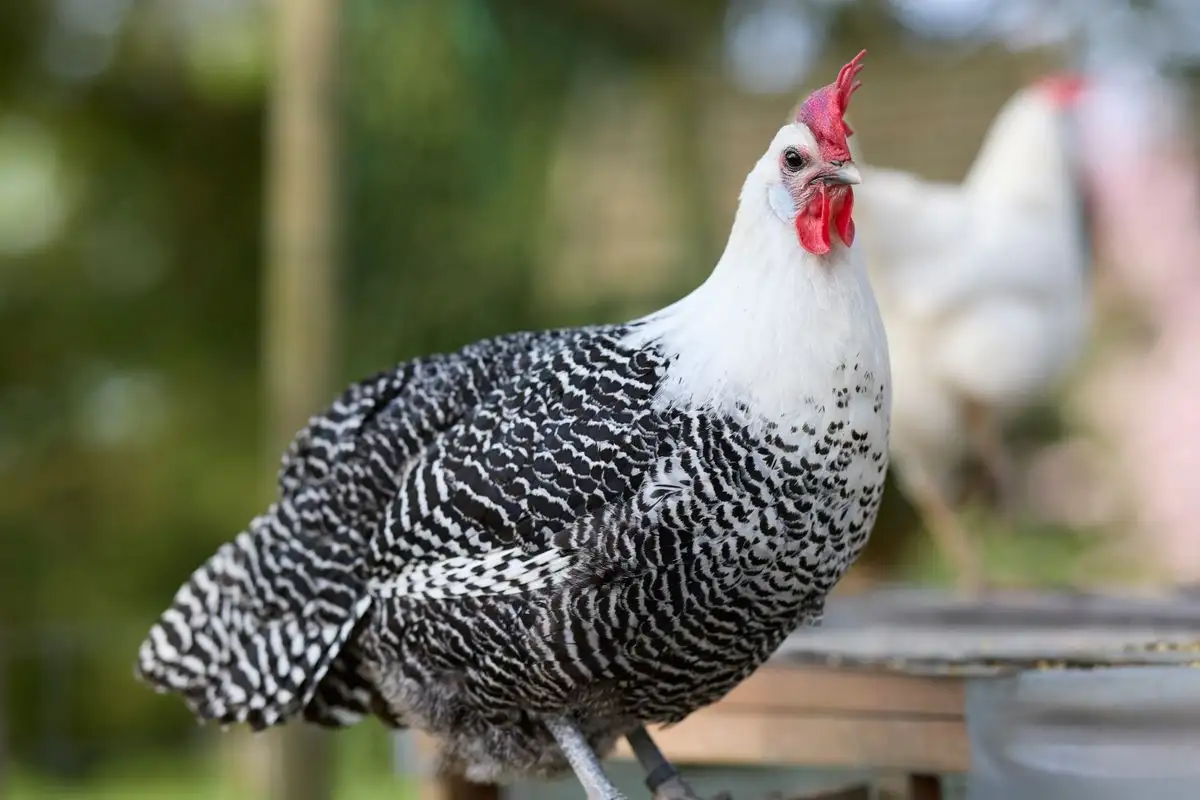
It's about twenty minutes before sunrise, and the waterer has a skin of ice on it that I break with the flat of my hand. The pop door sticks when it's this cold. I lift it, and the first bird down the ramp is the red sex-link, at the feeder before my eyes have adjusted, working the trough with that steady, uninterested rhythm she keeps all day. The second bird is a barred Plymouth Rock, nine years old this spring, and she stands in the doorway with her head turned sideways, looking past the run, past the fence, at the woodline. Then she comes down and starts scratching leaves out from under the lilac like something's buried there. Nothing is. She does it every morning anyway.
That's most of the difference, right there in one doorway.
What the two words actually mean, and why it matters at the gate
Heritage is a definitional term, and it gets used loosely. The working version: a breed listed in the American Poultry Association's Standard of Perfection, with a documented history, that breeds true. Hatch its eggs and you get more of the same bird. Breed-conservation groups tighten the definition further, adding natural mating, a long productive outdoor life, and slower growth. That describes a bird shaped by farm conditions where it had to find a good part of its own living and sit on its own eggs.
A production hybrid is a cross, not a breed. The red and black sex-links most backyard keepers see are made by crossing two separate lines so the chicks can be sorted by down color at hatch. The big commercial brown-egg and white-egg layers work the same way: proprietary lines, combined for one narrow result. They don't breed true. Hatch a sex-link's eggs and you get a mixed bag of whatever her parent lines were carrying.
The history explains the split. Through the late 1800s and early 1900s, farms ran standardized breeds because that's what existed. A Barred Rock or a Rhode Island Red gave you eggs, a Sunday roaster, a broody hen to raise the next generation, and a bird that could feed itself in the orchard. When egg production moved into confinement houses in the middle of the twentieth century, the economics started rewarding a different set of traits, and the crossing programs followed the money. Neither outcome is a mistake. They were optimized for environments that don't resemble each other at all.
Foraging drive, broodiness, temperament: what you notice by Thursday
The behaviors show up fast.
Foraging drive comes first. Heritage birds, especially the lighter Mediterranean types like Leghorns, Minorcas, and Andalusians, treat the whole property as a feed lot. They range far, they fly better than you expect, and they find every gap in a fence. That isn't mischief; it's the trait that kept them fed for a hundred years. Confine that bird to a bare run and the drive has nowhere to go, so it turns into pacing along the wire. The heavier American and Asiatic breeds, the Rocks and Wyandottes and Brahmas and Cochins, scratch just as hard but don't travel as far. Brahmas and Cochins are big and poorly built for flight: they want low roosts and a ramp, and feathered feet want dry ground under them, not mud.
Hybrids are usually content to stay near the feeder, which is exactly what they were selected for. They handle a small run with far less visible frustration than a Leghorn would.
Broodiness is the divider that surprises people. Production hybrids have had it largely selected out. A hen that quits laying to sit a nest for three weeks is a loss in a house that counts eggs per bird per day, so the trait got bred away. If you keep hybrids, you will almost never watch a hen hatch and raise a clutch, and if a hawk takes one of your layers, the replacement comes from off the property. Heritage hens go broody, sometimes inconveniently, sometimes in July heat, sometimes twice in one season. That same trait is the only free chick-raising system you'll ever have on the place.
Temperament runs the full range, and the labels people use don't survive contact with real birds. Hybrids tend to be calm in close quarters. Heritage temperaments split hard by class: the Mediterranean breeds are alert, quick, and uninterested in being picked up; the dual-purpose Americans are usually steady; a game breed is an entirely different conversation. A hybrid that has been handled a lot is friendly because of the handling. A flighty Leghorn stays flighty no matter how many times you carry her across the yard.
Two different laying curves, and a long tail on one of them
A production hybrid is built to front-load. Roughly speaking, she starts around 18 to 20 weeks, climbs to nearly an egg a day, keeps laying straight through winter as the daylight shrinks, and holds that pace through about her second season. Then the curve falls off fast. By year three many hybrids are laying sparsely or not at all, and you're looking at a bird who is now purely a pet.
A heritage hen starts later, often 20 to 24 weeks, and later still for the big dual-purpose breeds. Her first year is a lower number than a hybrid's. She lays through spring and summer, goes broody if she's the broody type, molts in fall, and shuts down for winter when the shortening days tell her to. Next spring she starts again. That cycle can run five, six, seven years, and a hen still laying at eight isn't unusual in a flock that's been kept well.
So the honest question isn't how many eggs. It's how long you want the same birds. If the flock is a rotating production unit and the names don't matter, the hybrid curve is efficient. If you want to know the birds, name them, and still collect a few eggs from the same hen when your kids are in middle school, the heritage curve is the one that pays out over years instead of two seasons.
Space, confinement, and the shape of the setup
This is where breed choice and habitat either match or don't.
A hybrid in a compact, shaded, well-organized run is fine. A hybrid in the same run with too many flockmates and nothing to do is a bird with no outlet. Confinement tolerance is not the same thing as confinement thriving, and you'll see the difference in the litter and the wire before you see it anywhere else.
A heritage bird with a strong foraging drive needs either range or a run built with interest: roosts at different heights, a brush pile, a couple of shrubs, a loose area to work, something to hop onto. Ten square feet per bird in the run is the number most people start with. A ranging heritage flock usually wants more, and a confined one wants that space arranged in layers rather than spread flat. Vertical clutter buys more usable bird-space than extra square footage does.
Then match the body to the furniture. Heavy breeds want ramps and roosts under about eighteen inches. Light breeds will take the highest roost in the coop and the top of the run if you leave it uncovered. Feathered feet want dry footing, which usually means a roofed section or a footing change, not a bigger run. And a breed that flies will treat a four-foot fence as a suggestion; a heavy breed won't test it at all.
Working backward from your goals
Sort the questions out before you sort the breeds out.
- Do you want the same birds for eight years, or a laying flock you turn over every couple of seasons? Long-term leans heritage.
- Do you want a hen to hatch and raise chicks, or is that not in the plan? Broodiness lives almost entirely on the heritage side.
- Is there a rooster? A heritage flock can close its own loop. A hybrid flock can't breed true even with one.
- How much range can you honestly give them? A big brushy lot makes heritage foraging drive an asset. A small fenced run makes hybrid tolerance an asset.
- Do you want eggs in January without running a light in the coop? That's the hybrid strength, and it's the one place the trade-off clearly favors the keeper's convenience over the bird's instincts.
- Are these pets who also lay, or layers who happen to be alive? Both answers are legitimate. Whichever one you give decides most of the rest.
The trap is picking from a chart of egg numbers and then discovering you've built the wrong run for the bird you brought home. The habitat is the fixed cost. The breed is the variable.
What the November count looks like from here
Back at the pop door. The red sex-link is on the feeder and will be on it at noon. The Rock is at the fence line again, working the same seam where the ground meets the posts, and later she'll be in a nest box, and in a few weeks she'll stop laying altogether and look ragged for a month, and then sometime in February she'll start again like nothing happened.
That's the exchange. Fewer eggs from her, in return for a bird that still knows how to be a chicken on her own, in a run I built to give her something to do.
The best breed is the one whose worst habit you can live with. A hybrid's worst habit, from where I stand, is having almost nothing to do with herself. A heritage hen's worst habit is doing exactly what she wants, wherever she wants, including the neighbor's side of the fence. Pick the one you'd rather correct.