The Old Bloodlines Behind Heat Tolerant Chickens, from Minorca to Transylvania
Heat tolerance in chickens travels with bloodlines out of specific places — the Balearic island of Menorca, the Tuscan port of Livorno, the dry south of Spain, and the basin country that produced the Transylvanian Naked Neck — and those lineages reached U.S. farmyards on ships and in immigrant farm stock long before anyone thought to sell "heat-hardy" birds as a category. The trait was never a label on a catalog page. It was architecture: how large the comb is, how much feather covers the body, how much mass the bird carries, how much bare skin it can put against moving air. Following the route explains the body. Picking a name off a list does not.
The tag on the cage is not the bird
I want you standing beside me in the poultry barn at a county fair in the second week of August. The roof is corrugated steel and it ticks as it expands in the sun. Three box fans run at the end of the aisle and they do nothing except push the smell of pine shavings and dust from one end of the building to the other. Almost every bird in that row is standing with its beak open, wings held slightly away from the body — doing what a chicken does when it cannot sweat. It dumps heat through the comb, the wattles, the shanks, the bare skin around the eyes.
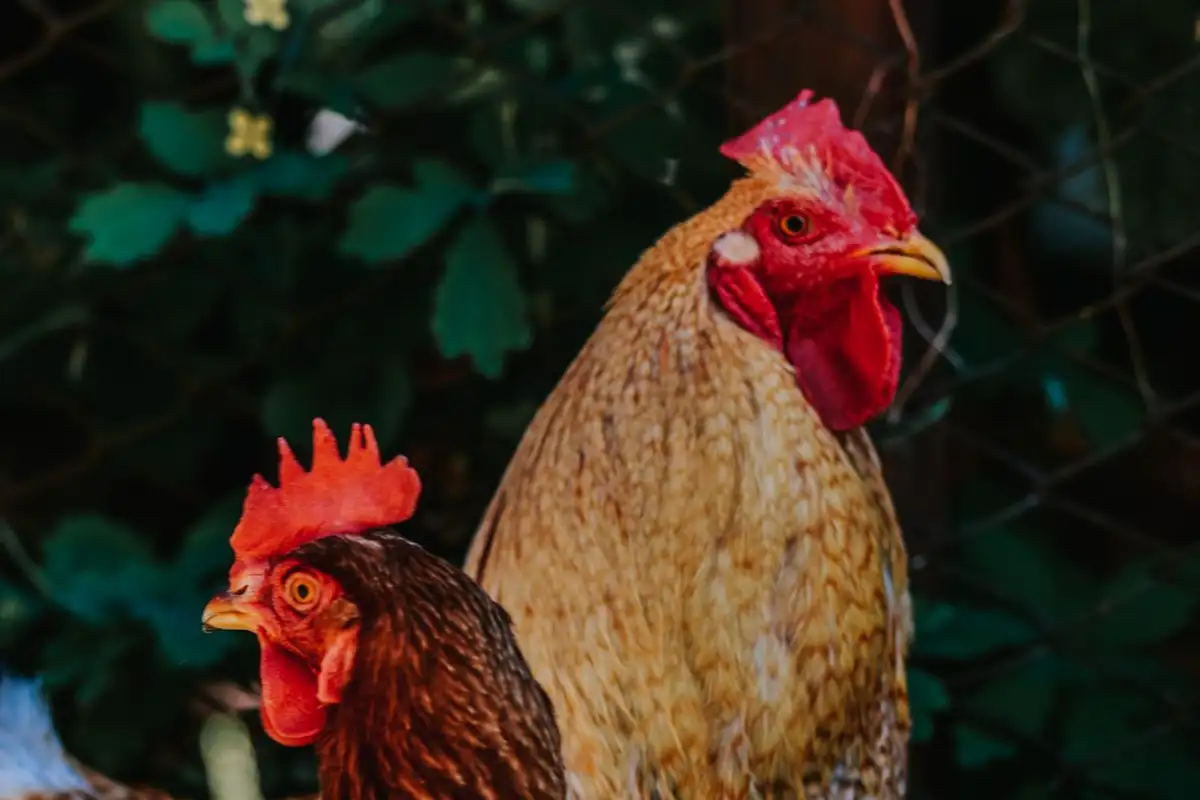
Then you reach one cage and the bird inside is doing something else. She is upright. She is not gaping. Her comb — and this is the part you notice first, because you cannot not notice it — is enormous, folded over one eye like a wet red handkerchief. The cardboard tag wired to the cage says Minorca.
Lean in and watch her for a minute. Watch the comb move when the fan swings past. That comb is not decoration and it is not a breed standard. It is the reason she is standing up while the birds on either side of her are hunched over their waterers. The tag on the cage is the name of a place. The comb is what the place did to the bird.
That is the whole reason I stopped reading breed lists and started reading bodies.
The Mediterranean class is a shipping lane wearing a climate's name
In U.S. poultry classification, the Mediterranean class collects the light-bodied, large-combed birds whose origins trace back to the Mediterranean basin — Leghorn, Ancona, Minorca, Andalusian, and a few others. People see the word "Mediterranean" and hear "warm weather." That is a coincidence of geography, not the meaning of the class.
The class is really a set of ports and coastlines. Livorno. Menorca. Andalusia. The birds did not get grouped together because someone tested them in heat chambers. They got grouped together because they all came off the same water, on the same trade routes, into the same harbors, and they all carried the same general body plan: light frame, thin plumage, big exposed comb and wattles, long shanks. Once you see the class as a map instead of a thermometer, everything downstream makes more sense — including why the birds landed where they landed in North America.
Livorno, and the bird that became the template
The Leghorn takes its name from Livorno, a port on the Tuscan coast, and the bird was refined in Italy before it reached North America in the nineteenth century. Light body. Big single comb. Thin feathers that lie close.
That combination became the template for what a warm-climate laying bird is supposed to look like. It is worth slowing down on that word "template," though. The Leghorn did not become the template because fanciers voted on it. It became the template because it worked in warm places, and because it laid a lot of white eggs on very little feed, and because those two facts together made it the bird that every subsequent light-bodied layer got compared to.
The awkward part of that history is that the Leghorn also got pulled into industrial egg production hard enough that the commercial white layer and the farmyard Leghorn are now quite different animals wearing the same name. When I see a barnyard Leghorn scratching through a Georgia yard, I am not looking at the industrial bird. I am looking at a survivor of the older line. Worth remembering before you assume the name tells you what the body does.
Menorca is a windy limestone island, and the Minorca is built like it
The Minorca comes from Menorca, in the Balearic Islands off Spain's east coast — hot, dry summers, hard limestone, wind coming off the water most of the year. Among the Mediterranean class, it is the largest and heaviest-framed bird. Not by a little.
Here is where the reasoning gets interesting, because a big body is not obviously an advantage in heat. Mass holds heat. A heavy hen in August is a hen with more thermal inertia to shed. What offsets that on a Minorca is everything else: an exceptionally large comb, long wattles, and plumage that is comparatively loose and thin for a bird that size. The surface area to volume problem gets solved at the extremities instead of the core.
And there is a real tradeoff you should hear plainly, because it does not show up in warm-climate marketing. That comb is a frostbite liability. Anywhere the temperature drops hard and the humidity climbs, a big single comb on a Mediterranean bird is the first thing to get damaged. This is why old-timers in cold country either avoided the class or accepted that they were running a bird built for somebody else's climate. The trait is not free. It is just paid for in a different season than the one you were thinking about.
The Naked Neck came off the other end of the same trade world
The Transylvanian Naked Neck is the one that throws people, because it does not look Mediterranean at all. Transylvania is the basin inside the Carpathian arc — continental, not coastal, with genuinely hot summers and genuinely cold winters. The bird carries a gene that reduces feather coverage along the neck and over parts of the body, leaving a bare, reddened strip from the base of the skull down to the crop. In older American farmyard usage it moved around under a handful of other names, and it moved as barnyard stock, not as a show bird.
Watch one on a hot afternoon and the mechanism is not subtle. That bare neck is a radiator. The reduced overall feathering means less insulation over the whole body, which is exactly what you want in July and exactly what you do not want in a January cold snap. I have watched them tuck their heads down and hunch against a hard freeze, and they look smaller and more miserable than a heavy-feathered bird does. They get through it, but they are not built for it.
The reason I put the Naked Neck in the same article as the Minorca is that the trade route is the same story told twice. Poultry moved around Europe along rivers and livestock roads and markets, and it moved out of Europe on ships. A bird from a hot basin and a bird from a hot island ended up in the same American farmyards because farmyards take what arrives and keep what works.
Andalusia, where the blue does not breed true
The Andalusian is associated with southern Spain, and it is famous for blue plumage. The blue is worth understanding as a lineage fact rather than a color fact, because it does not breed true. Blue to blue produces black, blue, and splash chicks in the same hatch.
That single genetic detail reshapes how you read the breed's history. Nobody kept Andalusians as a color project in the way a modern breeder keeps a color project, because you could not — half the chicks came out the wrong color every time. You kept them because they were a working laying flock in a hot dry place that happened to throw a lot of pretty blue birds. The blue was a byproduct. The bird underneath it was the point.
Which also means the Andalusian that reached North America arrived as a variable population, not a fixed type. That matters for anybody tracing old southern farm stock, because a lot of what got called "blue game" or just "blue barnyard" in the nineteenth century was Andalusian blood moving through a general-purpose flock, unrecorded.
How the birds actually got into U.S. farmyards
The honest answer is: through ports, and mostly without paperwork.
Ships carried live poultry as ships' stores — eggs and meat that walked aboard and could be eaten fresh weeks out. Coastal trade put birds ashore at every stop. Immigrants brought stock in crates. Nineteenth-century exhibition and importation added another wave, this time with names and pedigrees attached, but the birds that actually ended up in farmyards were mostly the ones that walked off a dock.
Here is the part I find genuinely satisfying, and I want to be clear that this is reasoning rather than a documented record. A bird that came off a Mediterranean ship and landed in Charleston, or New Orleans, or along the Gulf Coast, or in coastal California, had already been selected — by generations of farmers in Menorca or Livorno or Andalusia — for a climate that looks a great deal like the one it just stepped into. Long hot summers. Humidity. Mild winters, mostly. The match was not an accident of fashion. It was a match of conditions.
Then the barnyard did what barnyards do. The bloodlines blended. A Minorca crossed with whatever was already in the yard, and the offspring went back into the general flock, and the comb stayed big and the frame stayed light and nobody wrote down where it came from. A large amount of the heat tolerance sitting in old southern farm stock is Mediterranean in origin and completely anonymous.
The vocabulary is older than the marketing
One more thing, because it changes how you read everything else. Early twentieth-century poultry writing already described southern European breeds as suited to warm, dry conditions. A hundred years ago, somebody stood in a hot yard, watched a big-combed light-bodied hen hold up better than the heavy birds around her, and wrote it down.
That is the tell. The vocabulary of climate adaptation in poultry predates modern hatchery marketing by roughly a century. All the "heat-hardy breed" framing you see now is a much later coat of paint on an observation that farmers made for themselves, in their own yards, with their own eyes. Which means the observation was describing real farm performance rather than selling a bird — and you can trust the observation even when you do not trust the packaging.
What I actually do with all this
I do not go looking for a breed name. I go looking at four things, in this order.
Comb and wattles. Large, exposed, well-vascularized surface is a heat radiator and a frostbite risk, in that order, depending on the season you are worried about.
Feather coverage. Thin, close, loose plumage sheds heat better than dense, tight, downy plumage. A naked neck is the extreme version of the same idea.
Body mass. More mass means more stored heat and slower cooling, which is why the big Mediterranean birds compensate with comb and plumage instead of frame.
Bare skin. Shanks, face, neck, the area around the eye. Every square inch of exposed skin is a place heat leaves the body.
Run those four checks on a bird and you will know more about how it handles August than any tag on any cage will tell you. That is what the old bloodlines actually left us — not a shopping list, but a set of solutions to specific places, arrived at slowly, by people who had to live with the results.