That Oversized Egg Is the Worst One You Could Set for Hatching
The biggest, roundest egg in the nest basket is almost always the wrong one to set. An egg that visibly outsizes its neighbors is usually a double-yolker, and a double-yolker is not a setting egg — it belongs in the kitchen bowl, not the tray. The only evidence a keeper has before anything is warmed is the outside of the egg: color, shape, texture, and the small flaws on the surface. That exterior read has to carry the whole decision.
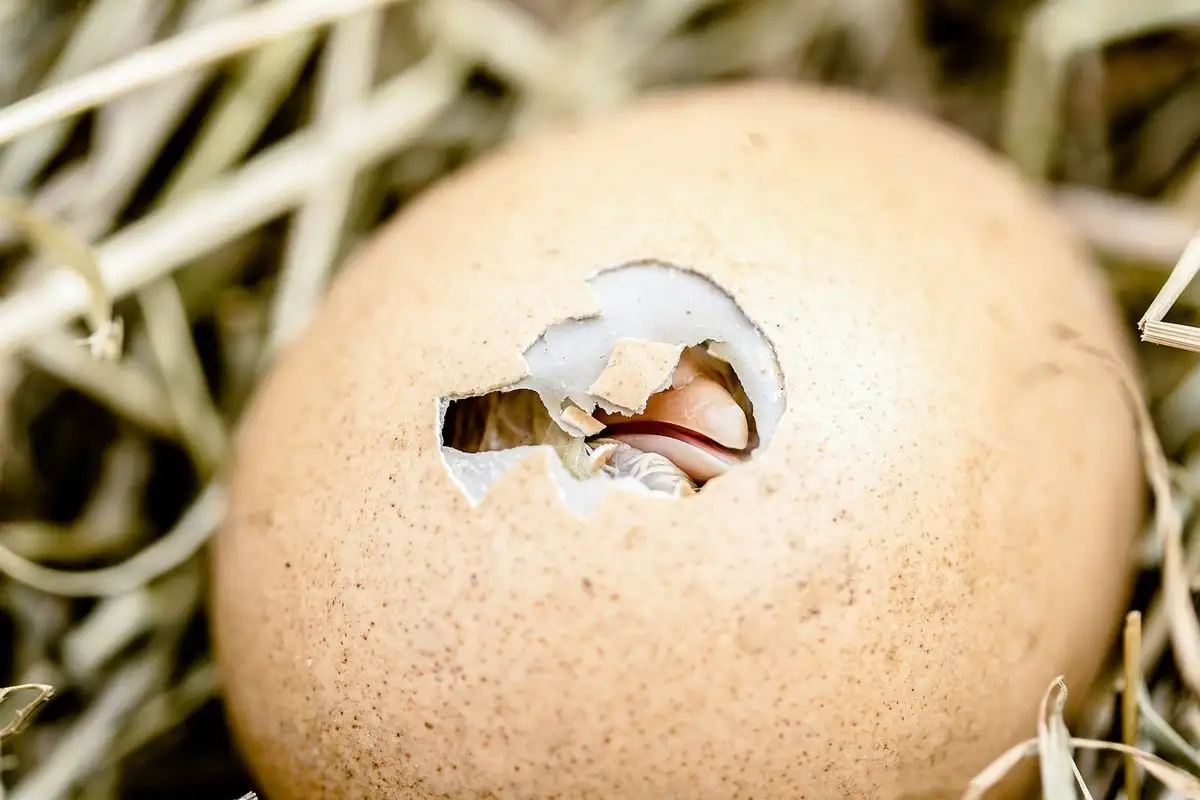
I do my sorting on the kitchen table, dish towel folded flat under the basket, coffee going, because that is where the basket ends up no matter how the morning started. I don't dump it out. I take the eggs one at a time. One egg in my hand, thumb over the blunt end, fingers around the point, a slow turn. Then up to the window so the light rakes across it at an angle. Then it goes down in one of three places: the setting tray on the left, the kitchen bowl on the right, and a small look-again spot behind me for anything I can't call in one pass. By the bottom of the basket, the look-again spot is usually down to a single egg, and by then I've decided.
Color is a breed signature, not a grade
The blue-green egg, the dark copper-brown, the plain white — the color is decided by the hen's breed and written onto the shell on the way out. It says nothing about what is happening inside. A blue or green egg is neither better nor worse than a brown one for setting. It's a blue egg. That's all it is.
So color never wins an egg a place in the tray. What I use it for is bookkeeping — remembering which hen is laying where, and noticing when the finish of a shell looks wrong. Chalky patches, mottling, a surface that looks like it shed its top layer in spots: those go right, to the kitchen side.
The egg that makes you stop
There's always one that makes you stop. It's wider than the rest, not just longer, and it sits heavier in the palm than its size should account for. Set beside a normal egg it looks like a prize.
It isn't. When a hen lays an egg that oversizes everything around it, it's usually carrying two yolks, or one yolk and an interior that never had room to arrange itself. A double-yolker is not two chicks in one shell, however it looks in the skillet, and it is not the egg I want holding down a slot in a tray I'm trying to keep uniform.
The instinct is that a bigger egg makes a bigger, sturdier chick. I've never seen it work out that way, and I've stopped trying to talk myself into it.
What your thumb finds before your eyes do
Roll the egg between thumb and forefinger, then along the side of your hand. A sound shell has a faint grit to it — not rough, just a dullness you can feel. A shell that feels like fine sandpaper, or that gives the smallest bit under a thumbnail, is thin, and thin goes right. So does anything with ridges: a raised seam running down one side, a faint corrugation around the middle. Those are shells that hardened unevenly, and a tray is no place to find out what that means.
Pimples, dents, and scuffed patches move over too. Watch for a polished, glossy spot where the rest of the shell is matte — that's usually where the bloom is worn or gone. What I want is boring: a clean, even shell with its dull matte finish intact from end to end.
Hairline cracks are the ones people miss, because they close up. Hold the egg at the window and turn it slow; the light catches a hairline as a thin bright line, there and gone. A cracked egg never makes the tray. Neither does a heavily soiled one — dried mud, a smear that's set, shavings glued on with something wet. I don't try to save it. It goes in the bowl on the right and I don't spend another minute on it.
Small, pointed, and otherwise off-pattern
Eggs from a hen in her first season are the other end of the problem. Small, sometimes pointed, occasionally with a shell you can nearly see through. I set them aside as a matter of habit.
That's a choice, not a rule. Keepers I know set pullet eggs on purpose and are pleased with what they get. My reason for passing is uniformity, not a belief that a small egg can't work. The tray is easier to manage when everything in it is roughly the same animal.
Shape works the same way. There's no magic outline — oval is fine, a long egg is fine. But if a tray is mostly oval and one egg is a near-perfect sphere, that's the one I look at twice. Not because round is wrong. Because it's the odd one, and odd is what I'm sorting out.
The part the outside read can't do
Here's the honest limit: none of this tells you anything about what's going on inside the shell. I can't see that at the table and I don't pretend to. The exterior read isn't a fertility check or a prediction. It's a cull. It exists to pull the obvious wrong candidates out of the pile so the tray is worth the space it takes up.
A matched tray is easier to read later
Matching size and shape inside a single setting does something practical. It keeps the hatch window tight. When everything in a tray is about the same size and shape, a fixed candling day shows me a row of eggs at roughly the same stage, and the one lagging behind stands out instead of hiding. Set a giant egg next to a pullet egg and you're reading a spread, not a set — and a spread is much harder to interpret when you're standing over it with a light in a dim room.
So the fat, glossy egg sitting on top of the basket — the one that looks like the best thing the coop produced all week — is the first one I lift out and walk to the kitchen. It goes in the bowl with the cracked ones and the chalky ones and the ones from the young hen. What's left in the tray is a row of eggs that all look like each other, and that's exactly the point. The read you make with your hands on the table is the only read you get.