Think Yolk Color and Shell Color Are Linked? Here's Why They're Not
No. Shell color and yolk color are produced by two separate systems in the hen, and neither one sets or predicts the other. Shell color is genetic and fixed before the egg is laid; yolk color is a running dietary record, built from the carotenoid pigments the hen took in while that particular yolk was forming. A hen laying a dark brown egg can hand you a yolk the color of pale butter, and a hen laying a chalk-white egg can hand you one the color of apricot. Sharing a shell is the only thing the two colors have in common.
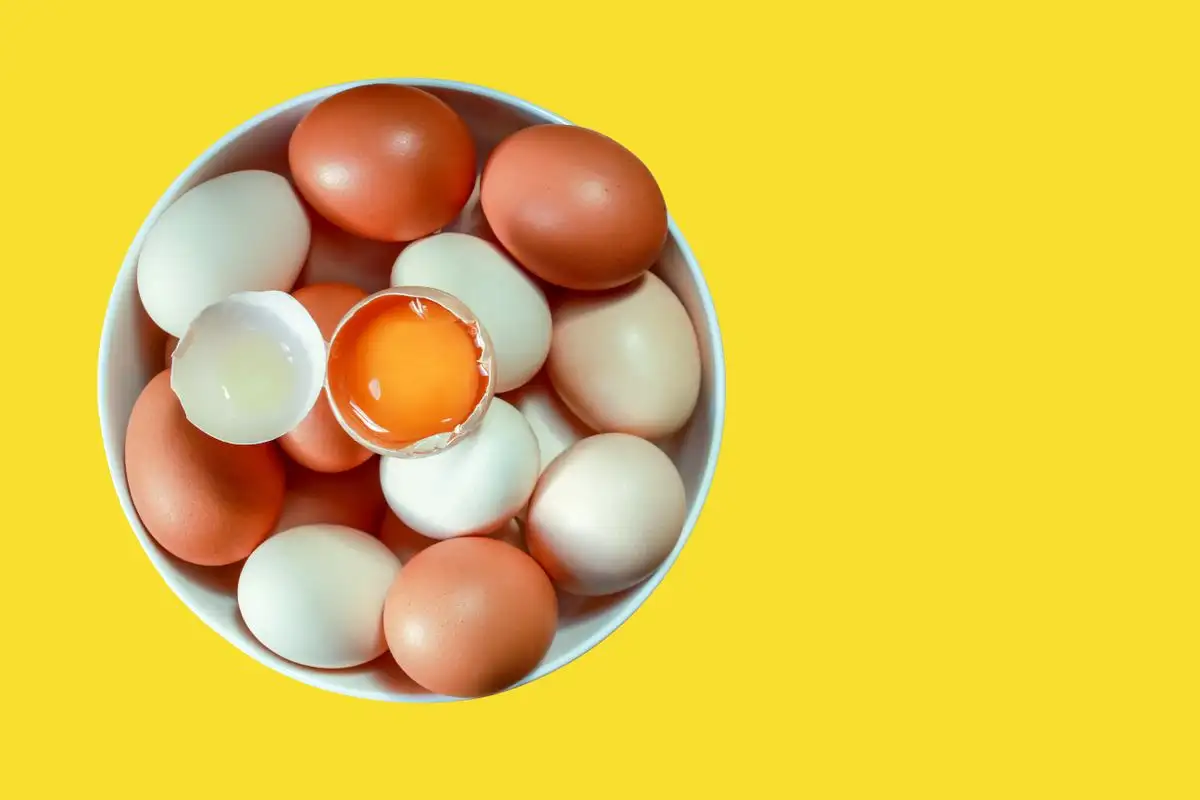
I crack five eggs into a stoneware bowl most mornings, and I've learned to read the two colors as separate instruments. The bowl is off-white, which matters — it gives me a neutral background so I'm not comparing a yolk against a cream plate and fooling myself. On a gray morning in late November the bowl sits on the counter under the window. I tap the first egg on the rim, pull the halves apart, and the yolk drops with a soft wet sound. Deep orange, nearly persimmon. The shell it came out of is a medium brown — the same medium brown that hen has laid since her first egg back in March. I write the date in the notebook and put a check under her name.
The next egg is from a different pen. Lighter shell, tan really. Yolk is a dull mustard, the color of a school bus that's spent ten years in the sun. Same morning, same flock, same feed scoop for both birds. Two colors sitting in the same bowl that have nothing to do with each other.
Shell color is decided before the egg is finished
Here's the part that made it click for me: a shell is built and colored in a single pass, in the last day or so before the egg is laid. Every eggshell starts as the same white calcium carbonate, laid down in the shell gland. If the hen carries the genes for brown shell, she paints protoporphyrin onto that white base in the final hours, mostly on the outer surface. That's why you can sometimes scratch a brown shell and see lighter shell underneath, and why the inside of a brown egg is white. Blue and green shells are a different pigment, biliverdin, deposited earlier and through the full thickness of the shell — crack a blue egg and the inside of the shell is blue.
Either way, the color is locked in before the egg sees daylight. Nothing the hen eats that morning changes it. Nothing she eats that month changes it, either.
Which brings up the old rule of thumb: white ear lobes, white eggs; red ear lobes, brown eggs. It holds across a lot of breeds and fails in enough of them that I would never bet a hen on it. I use it as a first guess, nothing more.
Why the mix-up makes perfect sense anyway
Where I live, the birds standing on green grass in April are almost always the big brown-egg breeds — the Orpingtons, the Rocks, the Reds. The white-egg Leghorns tend to be in a smaller pen, or in someone's suburban run with no pasture at all. So every pasture egg you open is brown and orange, and every pale yolk you meet is inside a carton from a hen that never touched grass. Two variables move together in your own backyard, and your brain quietly welds them into one cause.
That's not a dumb mistake. It's an obvious one. The correction isn't to distrust your eyes, it's to notice that you were watching two things at once and only one was doing the work.
Yolk color is a timeline, not a snapshot
Carotenoids — lutein, zeaxanthin, the pigments in green plants and in yellow corn — get pulled out of the gut and packed into the developing yolk. A hen eating nothing green deposits almost none of them and lays a pale yellow yolk. A hen working through grass, clover, and bugs lays down more, and the yolk swings toward orange.
But it doesn't happen overnight. A yolk grows inside the hen across a stretch of days before it's enclosed in its membrane and sent down the oviduct. So the yolk you crack this morning is a report on last week's pasture, more or less. When I move a pen onto fresh clover, nothing changes for the first several days, then the yolks step up over about a week. Move them off it and there's the same lag on the way down.
That's the piece most explanations skip. If you change something on Monday and crack an egg Tuesday morning looking for a difference, you haven't learned anything — you tested too early. Give it a week before you believe what you see.
What a season looks like from the bottom of a bowl
I keep a column in the notebook for yolk shade, and it fills in a curve across the year without me doing anything to the feed. February eggs, when the ground is frozen and everything green is dead, come out mustard yellow. By late April they're amber. June is when they hit their deepest orange, and they hold there until the first hard frost knocks the clover back. Every one of those eggs came out of shells that never changed color.
I don't rank the yolks. I read them. The bowl is a foraging log, and it costs me a second of attention I was already spending.
Some commercial operations add pigment sources to their rations so the cartons look uniform from week to week. On my place the yolks do whatever the pasture says. That's the tradeoff: consistency or information, and I'd rather have the information.
Two instruments, two different questions
Once you stop expecting them to agree, both colors get more useful.
Shell color answers a question about identity. In a mixed flock, shell color plus shell shape plus egg size is the fastest way I have to know which hen laid what without sitting in the coop waiting. It's an ID tag that costs nothing. Yolk color answers a question about behavior — what that bird has been walking around in for the past week.
Shell color also does move, just barely, and the movement is worth knowing about. In my flock a hen's shells run a little lighter toward the end of a long laying cycle, and after a molt the first eggs of the new cycle come out deeper and usually a touch larger. That's a narrow band, a few shades, and it tracks the hen's own cycle, not the feed sack. So when a shell changes, I look at the bird: age, molt, illness, stress. When a yolk changes, I look at the ground.
Two colors, two questions, no overlap. The only place they ever meet is at the bottom of the bowl.