Brooder Heat Isn't One Right Temperature, It's a Gradient
Brooder heat is a gradient you build on purpose, not a number you hit. Put the heat source at one end of the brooder and leave the far end genuinely, noticeably cooler, so each chick chooses its own distance from the warmth and then re-chooses it every few days as it grows. The familiar figure of about 95 degrees Fahrenheit at chick level in week one, dropping roughly five degrees a week, is a starting reference for the warm zone itself, not a setting the whole box has to match.
I set up my first brooder the other way, because that is how the instructions read. One lamp, centered. One thermometer, hung from the middle of the lid at about my own eye height. The whole thing was tidy and symmetrical and wrong in a way I couldn't name for two weeks.
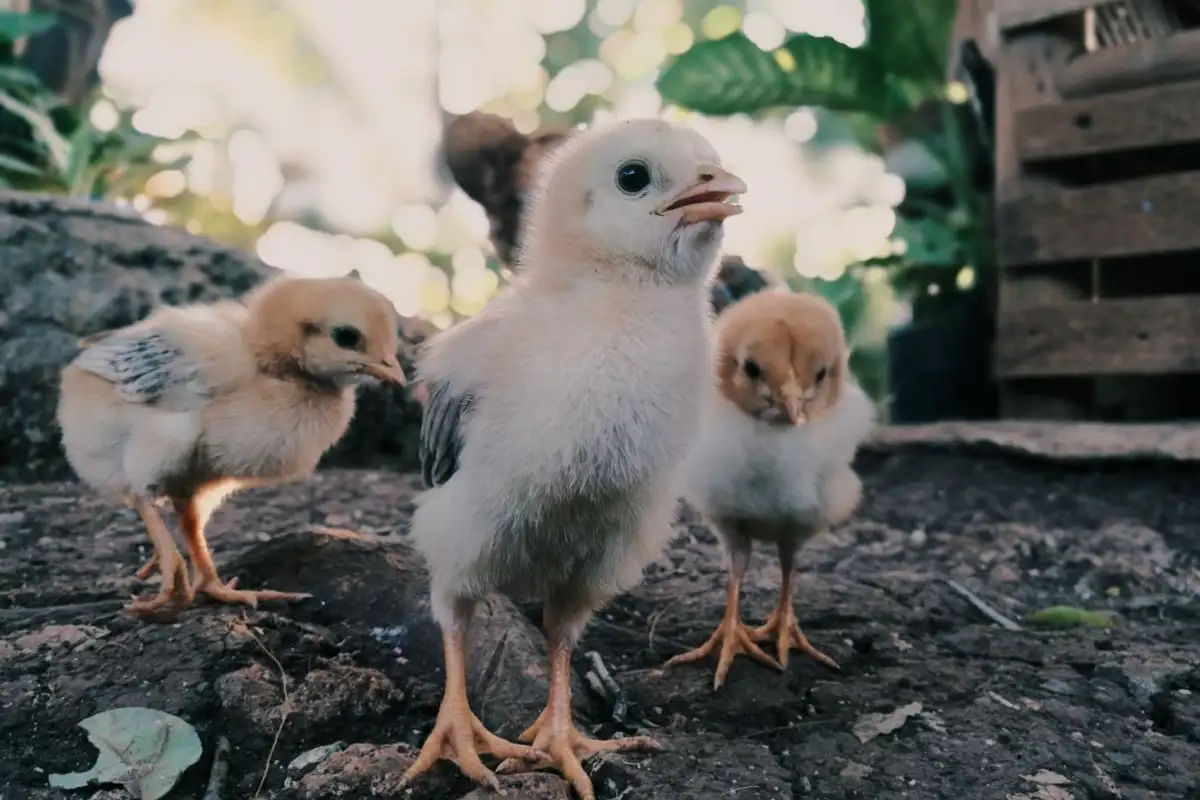
What fixed it was a second batch of chicks and a shed that was colder than I expected in March. I clamped the lamp at one end that time, not out of wisdom but because the lid sagged in the middle and the far corner was the only spot with room. By the second morning I was kneeling in pine shavings with a mug going cold beside me, and I could see the whole thing laid out like a map. A loose knot of chicks under the lamp. A few on the edge of the light. Two out near the waterer, scritching and completely unbothered. Nobody had told them a temperature. They were using distance the way they'd use distance from a hen.
That's the reframe I'd hand to anyone starting out: you are not setting a temperature, you are laying out a space with a near end and a far end and letting the birds do the fine adjustment.
One warm end, one cool end
The single most useful change is moving the heat off center. A lamp in the middle of a brooder is a lovely, even, useless thing. It warms the middle and leaves two half-cooled ends, neither of which is far enough from the light to be a real refuge. Put it at one end and you get one warm zone and one long run of cooler floor, and the chicks get to pick a spot on that line instead of being stuck in a lukewarm average.
It also solves the water problem without you thinking about it. Water in the warmest corner goes stale and gets fouled fast, and chicks hang around water more when it's the only comfortable place to be. With the heat at one end, the waterer sits naturally at the far end or along a side wall away from the lamp, and the birds walk to it and walk back. That round trip is worth something. It's the closest thing in a brooder to the walking a chick does in a yard.
The number is a starting reference, not a rule
I still start at about 95 at chick level in week one and walk it down roughly five degrees a week. It's a decent convention and it keeps me from guessing wildly on day one. But I stopped treating it as the thing to be achieved, because the thermometer can only ever report one point in a space that has dozens.
So I clip the thermometer low, at the height of a chick's back, at the warm end. The reading there tells me what the warm zone is offering. It does not tell me what the far end is doing, and it never will. The far end is measured by looking.
Judging lamp height from the floor
Here is the mistake I made longest. I'd set lamp height by holding a thermometer up in the air near where my own face was, under the shade, and adjusting until the number looked right. Then I'd wonder why the chicks behaved like the heat was somewhere else.
Heat from a lamp lands on the floor, and the floor is much further from the bulb than the air is. The number that matters is at shavings level, under the cone of light, and the honest way to read it is to look at where the chicks settle. A crowd bunched in a tight knot directly below the bulb with clean floor beyond it means the warm zone is a bulls-eye when it should be a broad band, so the lamp comes down a notch or two. A crowd strung out toward the far wall and thin under the light means the warm zone is too weak, so the lamp goes up and the reach widens.
I raise the lamp a couple of inches at the start of each week rather than chasing the numbers on a schedule. The chicks are feathering, they're generating more of their own heat, and the gradient should be getting gentler anyway. If I'm lifting the lamp and the chicks reorganize themselves into a looser, more spread-out pattern, I've done it right.
Plates change the shape of the gradient
A radiant plate isn't a small lamp. It's a warm surface the chicks get under, and they touch it with their backs. When I set one up, the height is set by contact, not by air: low enough that a chick standing normally presses its shoulders into the underside, the way a hen's body settles over them. Legs at the right height, and a plate at one end.
The difference is that a plate makes a warm room rather than a warm spot. Chicks come out, eat, drink, cool off at the far end, and go back under. The gradient is still there, it's just compressed and it's vertical as much as horizontal, which is why the plate can be smaller than the footprint of a lamp's reach and still work.
I've used both. Lamps in a cold shed, plates in a spare room or a garage that holds some heat. A plate in an unheated outbuilding in February leaves you with a warm cave in a cold box, which is a different setup than a gradient, so I match the tool to the building.
When the brooder is too small for a gradient
This is the part nobody mentions and it matters more than lamp height. A gradient needs length. In a two-foot-square box, a lamp at one end warms most of the floor and the "cool end" is a fiction. You can fuss with the lamp all you like and you won't get a real choice for the birds.
My rule of thumb is that I want at least three feet between the heat source and the far wall for a small batch, and more for a big one. If I can't get that, I go up: a bigger tote, a stock tank, a plywood box with a wire panel, anything with one long axis. Extra floor space at the far end isn't wasted. It's the whole point.
The gradient shrinks on its own
Somewhere around week three or four I stop thinking of the brooder as heated and start thinking of it as drying out. The chicks are mostly feathered, they're spending their time at the far end, and the lamp is high enough that it's more of a suggestion. That's the gradient doing its job. The brooder is supposed to make itself unnecessary.
Which is why I don't chase a perfect number on any given morning. I set the warm end, leave a long cool run, put the water where it belongs, and then read the crowd. The chicks are not measuring the air. They're choosing a spot, and if they have a real spot to choose, the setup is already working.