Chicken Wire Fails the One Night It Matters Most
Judge a barrier by what an animal physically does to it — pull, pry, chew, push, reach through — and make mesh opening, wire gauge, and fastener method one decision instead of three. Chicken wire fails the night it matters because hexagonal poultry netting is made to contain birds, not to resist an animal that pulls; its light gauge deforms under steady pressure rather than surviving it. Buying a heavier roll of the same woven netting does not fix that, because the failure is not really in the roll. It lives in the assembly: what the opening lets through, what the wire does under load, and what actually holds the wire to the frame.
The hole was stretched, not cut
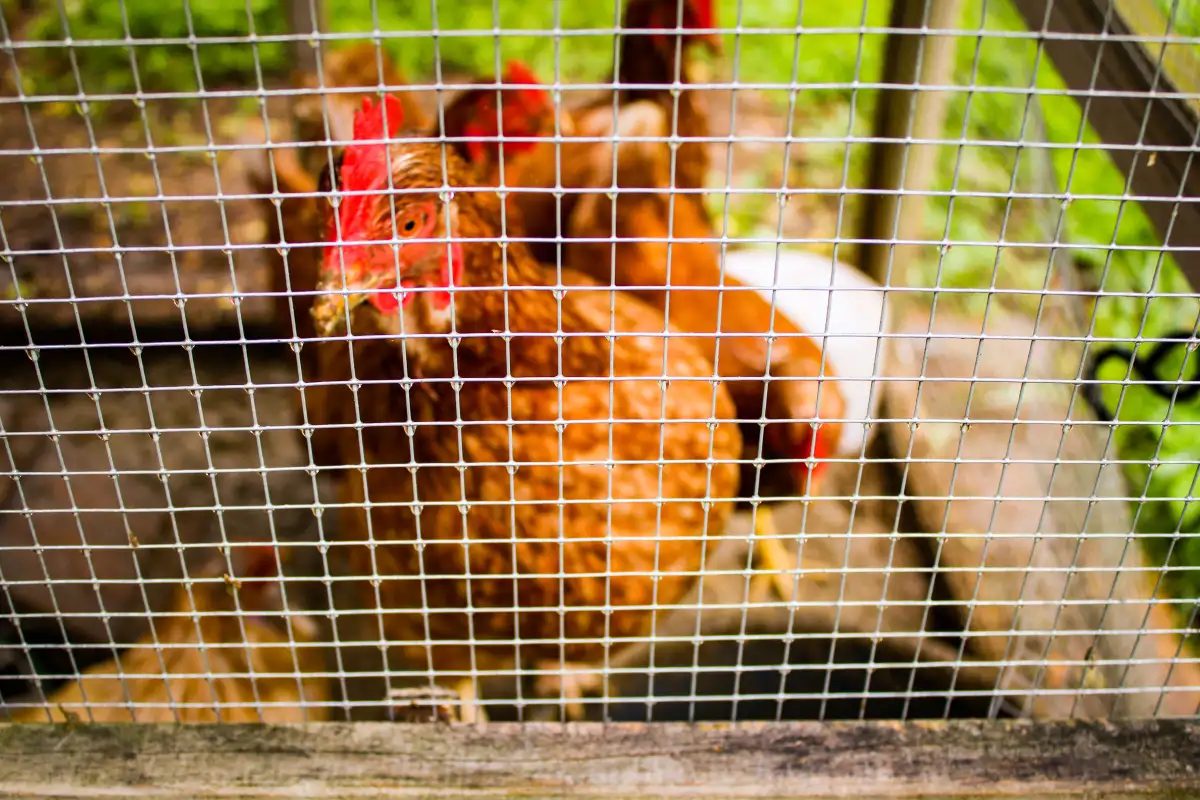
I found it a little after two in the morning, crouched at the end of the run with a headlamp and my sleeves pushed up. There was no cut wire and nothing chewed. The mesh was simply stretched — pulled into a long oval around a gap where two staples had let go of the top rail, the hexagons drawn out thin like something pulled from warm taffy. When I hooked two fingers into the opening and pulled toward my chest, the wire moved. Not far. Far enough. Something had put steady weight on it, and the metal had given up its shape instead of holding.
That is the part people miss when they stand in the aisle reading labels. A fence does not fail in a dramatic way. It fails quietly, at one point, at the one moment something hungry leans on it. And it is almost never the middle of a panel. It is an edge, a seam, a corner, or a fastener.
So when I walk a run now, I am not checking whether the barrier looks intact. I am running through the motions an animal would run through, in order.
Pull, pry, chew, push, reach through
Each of those is a different physical act, and each one asks a different question of your materials.
Pull is a raccoon with its weight on the wire, or a dog throwing itself at it. That asks how the wire behaves under tension and how far apart your attachment points are.
Pry is a nose and a paw working at an edge — the place where wire ends and wood begins, or where two panels meet. That asks how the wire is trapped against the frame and whether a gap can be widened.
Chew is rodents. They are rarely chewing the wire itself. They chew the wood frame, the plastic, the zip ties, the soft thing that makes the wire look finished. A chewed corner on a wooden frame is how a small opening becomes a large one.
Push is something heavy leaning and lunging. That asks whether the frame is anchored to anything or just standing there.
Reach through is the one that gets birds killed without anything being breached at all. An arm goes through the aperture, grabs at whatever is inside, and pulls. I have found birds dead at the wire on a fence that was still perfectly intact.
What the opening actually lets through
I test this with my own hand, which is the only measuring tool I trust. On one-inch welded wire, I can get four fingers through and up to the second knuckle. On half-inch, I get fingertips and nothing else. A raccoon's forepaw is smaller than mine and dramatically more dexterous — it can rotate, grip, and pull with a precision my hand does not have. So a one-inch opening does not fail because a raccoon fits through it. It fails because a raccoon fits a hand through it and works on whatever it can touch. Half-inch shuts that down for most small-mammal reaches as well.
But here is the thing the gauge chart will not tell you: aperture alone is not a barrier. Mesh is a cloth, and cloth behaves differently depending on how far apart it is supported. Half-inch hardware cloth in nineteen gauge strung tight between framing members sixteen inches apart is a drumhead. The same material spanning four feet unsupported bows and folds under a hand. Every time the mesh deflects, it works the fasteners, and every worked fastener opens a little more.
That is why gauge and fastener spacing are really one number. A heavier gauge with a slightly wider opening, held firmly and closely, will outperform a lighter gauge with a tighter opening that is flapping in the wind. You are not buying wire. You are buying a stiffness, and stiffness comes from the mesh and the support together.
Staples are not a fastener, they are a suggestion
I have pried my own staples out with a flat bar in about the time it takes to drink a cup of coffee. A staple holds wire to wood with a single wire-thickness of friction, and when the wire is pulled, the staple rocks in its hole and widens the hole as it goes. Every pull makes the next pull easier.
What works is spreading the load along a line instead of at points. Fender washers under screws do that — the washer clamps a circle of mesh rather than a sliver. A screwed-down wooden batten does it better. I run a 1x2 or 1x3 over the wire and drive screws every twelve to sixteen inches, sandwiching the mesh flat against the frame along its entire length. It is slow, it costs lumber, and it is the difference between a fence and a suggestion.
Two places get the most attention from me. The bottom rail, because a gap there is at nose level and everything tests it. And the top rail, because it is awkward to reach and it is the place where most people space their fasteners the widest. That floppy top edge is where my own failure started.
Outside the frame, one continuous piece
Mount the wire on the outside face of the frame, not the inside. Wire stapled to the inside face can be pushed inward — a bird on a perch leaning on it, or an animal already inside — and the staples do all the work. Wire on the outside face gets pressed against the wood instead of peeled away from it.
At corners, wrap one continuous piece around the post rather than terminating two pieces against it. A corner is two edges meeting, which means two directions to pull from.
Where panels do meet, overlap them by several inches and tie them together with wire every few inches down the full seam. Not three ties at the top and three at the bottom. The whole length. A butted seam is an eighth-inch slot running floor to roof, and a slot is exactly what a raccoon works at.
Tie the wall to the soil
Bring the same mesh all the way down to the bottom rail, then continue it outward along the ground as a skirt — somewhere in the range of twelve to eighteen inches, pegged down, and covered with soil or gravel so it does not spring back up. This is the point that ties the wall to the soil. Diggers do not dig under a wall. They dig at the junction where the wall ends and the ground begins, and an apron turns that junction into a dead end. A vertical buried edge works too, but the flat apron is easier to lay and rots more slowly.
Where it genuinely depends
Half-inch welded wire is expensive, heavy, hard to cut, and it will open your hands if you are careless. Running it over every square inch of a large run is a real cost, and pretending otherwise is not helpful.
If you need to economize, put the fine mesh where an animal can stand and reach — and remember that is not only the bottom. It is wherever there is a perch. If a raccoon can climb the wall and sit on the roof edge, the roofline is a reach point every bit as much as the base, and I have seen more than one run where the top was the soft spot. The middle of a tall wall is often the least interesting part of the barrier.
And if you are mixing materials, do not mix woven hexagonal netting into the assembly anywhere. A barrier is only as strong as its weakest cell, and predators do not test the average. They test the loose part, the floppy part, the part nobody likes reaching with a screw gun.
The test you can run tonight
There is no report card on a fence. It is quiet for two years and then it is not, and the difference between those two outcomes is a set of decisions you made standing in the yard with a headlamp or a coffee in one hand.
So go put your hand on it. Hook your fingers into the mesh and pull toward yourself. See where your hand passes through and how far. Press on the wire and watch whether it pushes in or bows. Find the edges, the seams, the corners, the top rail, and ask what an animal would do there, because it is going to do exactly that, once, on a night you will not be watching.