Blue Eggs Don't Come From One Breed, and That Changes How You Choose
Blue eggshells come from one dominant gene carried by a narrow line of breeds — Araucanas, Ameraucanas, and the mixed-line birds sold as Easter Eggers — while brown shells are pigment laid onto the outside of a shell that started out white. The two colors do not come from the same system at all, which is why you cannot feed a hen into blue and why buying a blue-egg breed does not promise you a basket of blue eggs. Choosing by color means choosing a breed family, and every family charges you for that color somewhere: in egg size, in laying rate, in how the flock handles a short winter, or in how predictable the shells turn out to be.
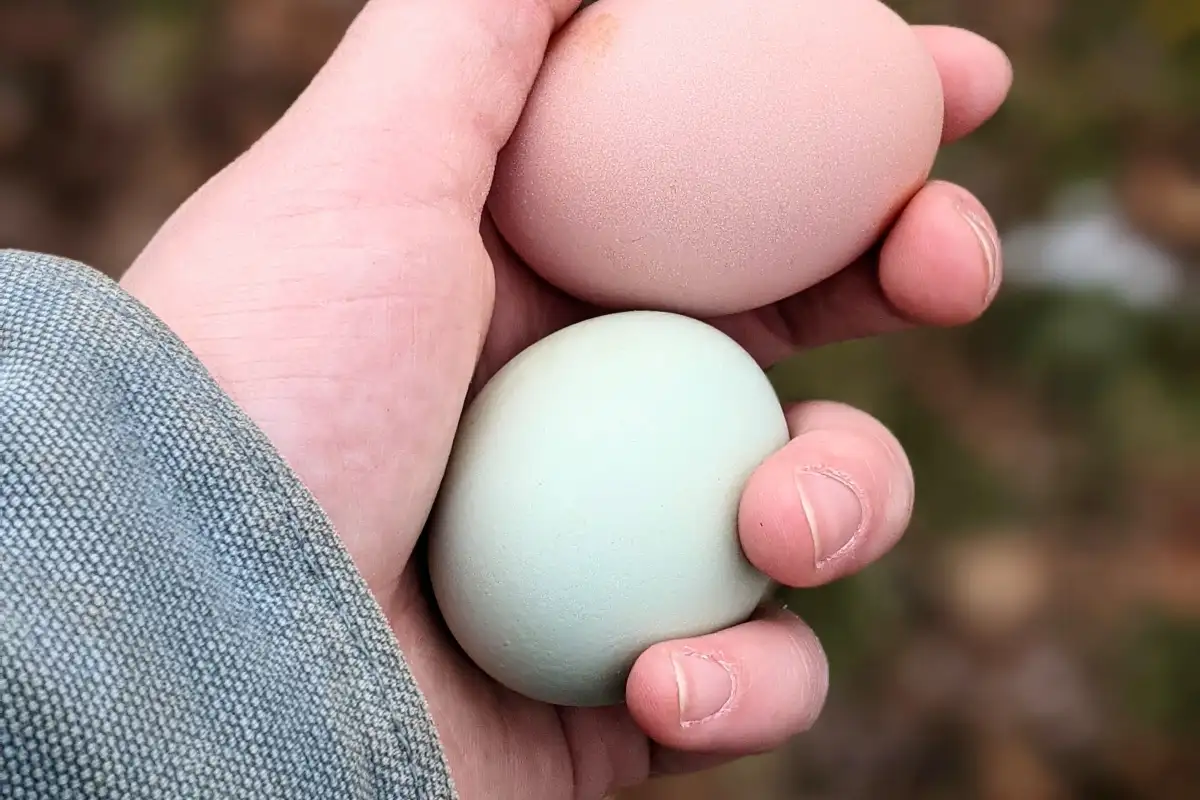
I was at my kitchen counter on a Saturday in late May, filling a carton for a neighbor who had asked, offhand, whether I could spare “some of the blue ones.” Twelve eggs sat in the wire basket, and the light coming over the sink was low and long the way it is at the end of spring. Four were pale blue. Three were olive — greenish-brown, muddy in a photograph, much better in the hand. Two were dark enough to read as black until I tilted them toward the window. The rest fell in between: a couple of ordinary browns, one that was almost pink.
Same coop. Same birds. Same sack of feed.
I had been keeping blue-egg hens for three seasons by then, and I still could not have told you, standing at the run with a coffee in my hand, which hen had laid which egg. That is the part that never makes it onto the hatchery page.
The color is decided before the shell exists
A shell is built in the shell gland over most of a day, and the two color systems work in completely different places in that process.
A blue shell is blue all the way through. The pigment — biliverdin, a bile pigment — gets deposited into the shell material as it forms, so if you crack a blue egg and look at the inside of the half you did not use, it is blue in there too. Brown works the other way around. The shell is finished first, white, and then a brown pigment called protoporphyrin is laid onto the outside in the last hours before the egg comes out. Crack a brown egg and the inside is white, or near it.
That is the whole test, and it takes five seconds. If someone hands you a green egg and calls it a blue egg with something added, crack it. Green shells are a blue base with brown pigment sprayed over the top, and on a good many of them you can see it.
The blue trait itself is strange. It traces back to a piece of viral DNA that landed near a pigment-transport gene in some ancestor bird, and because it is dominant, a hen needs only one copy to lay blue. That is also why blue shows up so easily in crosses. Breed a blue-egg hen to a brown-egg rooster and a share of the daughters will lay green or olive, because they inherited the blue and the brown both.
Three names, one gene, three different deals
When people say “blue egg breeds,” they usually mean one of three things, and the three are not interchangeable.
The Araucana is the original — a South American bird, rumpless, often tufted at the ears, laying a blue egg. It is also the fussiest of the three to keep, partly because the tufting gene is a hard one: two copies and the chick does not hatch. If you want Araucanas, you are signing up for a lower hatch rate and a bird with a very specific look.
The Ameraucana is the standardized, cleaner version — bearded and muffed, no tufts, no rumplessness, blue eggs, and it comes in a set of recognized color varieties. It is the bird you buy when you want a blue egg from a chicken that looks like a chicken and breeds true.
Easter Eggers are everything else. The name is a catch-all for mixed-line birds with blue-egg ancestry, and it tells you exactly nothing about what you will get. Some lay pale blue. Some lay olive. Some lay a green so gray it looks like a mistake. A few lay brown, because the blue did not come through, and no catalog in the country can tell you which pullet in the box is which.
There are a few other blue layers worth knowing — the Cream Legbar, with its crest and its auto-sexing chicks, and the hatchery birds sold under names like Whiting True Blue, which are essentially selected Easter Egger lines with a marketing budget.
Why the same hen hands you three shades in a week
Here is what surprises people most: within one flock of Easter Eggers, and sometimes from a single hen across a single week, the shade moves. I have a hen who has laid everything from a washed-out blue to a green with real depth, and I have never worked out what decides it from one day to the next. I do not think anyone has.
Two things do push the color around in ways you can plan for. The first is age. A pullet’s first eggs are small, and they are often thin on color — the pigment machinery takes a few weeks to settle in. Her eggs get bigger and generally more even as she goes. The second is the laying cycle itself. With the heavy brown layers, the darkest eggs come at the start of a cycle and the color fades as that cycle runs, which is why a Marans hen can hand you a chocolate egg in March and something closer to milk chocolate in August. The fade resets somewhat after a rest, but it never quite comes back to the same depth.
One more thing worth saying flatly: the depth of a brown egg tells you nothing about how fresh it is. A pale egg laid this morning and a mahogany egg from last week look exactly the way they look. Color is an ancestry document, not a date stamp.
The trade you make when you buy the color
This is the part I wish someone had told me before I ordered birds out of a photograph.
Egg size, laying rate, shell color, and body size are tied together by breed class, and you rarely get all of them at once.
The light Mediterranean breeds — Leghorns, Minorcas, Anconas — are the laying machines. Small-bodied, lean, a lot of eggs, and the eggs are white and on the smaller side. They also tend to be the flightiest birds in the yard.
The heavy brown-egg breeds — the Wyandottes, Orpingtons, Brahmas, and the big dual-purpose lines — lay fewer eggs and bigger ones, and they are calmer, easier to handle, and better in cold. If you want a genuinely dark brown egg, you are usually looking at something like a Black Copper Marans or a Welsummer, and you are accepting a hen that will lay in the neighborhood of a couple hundred eggs in a good year, not three hundred.
Blue is its own bargain. The blue-egg gene travels in a bird that is usually a decent layer and usually a lightweight, and the eggs run medium. You are trading a little size and a lot of uniformity for the color.
The breed charts will hand you a number for every one of these — well under two hundred for the big brown layers, well over two hundred for the small white ones — and it is worth understanding that those numbers are ceilings measured under good management, not promises. My own flock has never hit a chart number, and I do not manage badly. I just have winters and a small coop.
February looks nothing like May
Which brings me to the thing that reshaped how I plan.
The basket I filled in late May — blue, olive, near-black, all of it — was not the basket I had in February. It was not even close. Most breeds cut back hard or stop entirely as the days shorten, and the hens that keep going tend to be the ones laying brown or white, not the ones laying the fancy colors. Nothing about a hen’s shell color protects her from the calendar.
So a February basket out of a mixed flock is a small basket. Maybe six or eight eggs a week from a dozen birds if I am not adding light; fewer if the weather turns. Brown, mostly. The blue eggs come back when the days come back.
If you want color year-round, that is a planning problem, not a breed problem. It means knowing which of your birds keeps laying through the short days, accepting a bigger flock than you might have wanted, or accepting the seasonal gap and cooking differently from November through January.
I keep a tally on a clipboard in the feed room — nothing fancy, just date and color on the days I remember to write it down — and after two years it told me something no catalog would. My blue-egg hens are excellent from March through July and nearly useless in December. The plain brown hen in the corner is the one filling the carton in January.
What I do now when someone asks for blue eggs
The neighbor got her carton. She looked at it for a second and said, “They’re all different colors.” She sounded a little disappointed, I think, because she had been picturing one color.
That is the honest answer to the question, and it is why I stopped picking birds out of photographs. If you want blue eggs, you are not buying a color. You are buying into a family of birds — the blue-egg line — and agreeing to what comes with it: medium eggs, a lightweight hen, a range of shades instead of one, a fade in winter, and a certain amount of guessing.
What I do now is ask to see the hen. Not the catalog picture, not the breed description. If I am buying started pullets, I ask the seller which eggs came from which bird, and I look at a week of her eggs instead of one. Easter Eggers off a photograph are a lottery ticket. Easter Eggers off a specific hen whose eggs I have seen is a choice.
And if the basket matters that much to you — if you want the dark chocolate and the blue in the same carton in January — then you keep more than one family of breeds and you stop expecting a single bird to be everything. That is the trade. It has always been the trade. The color just makes it visible.