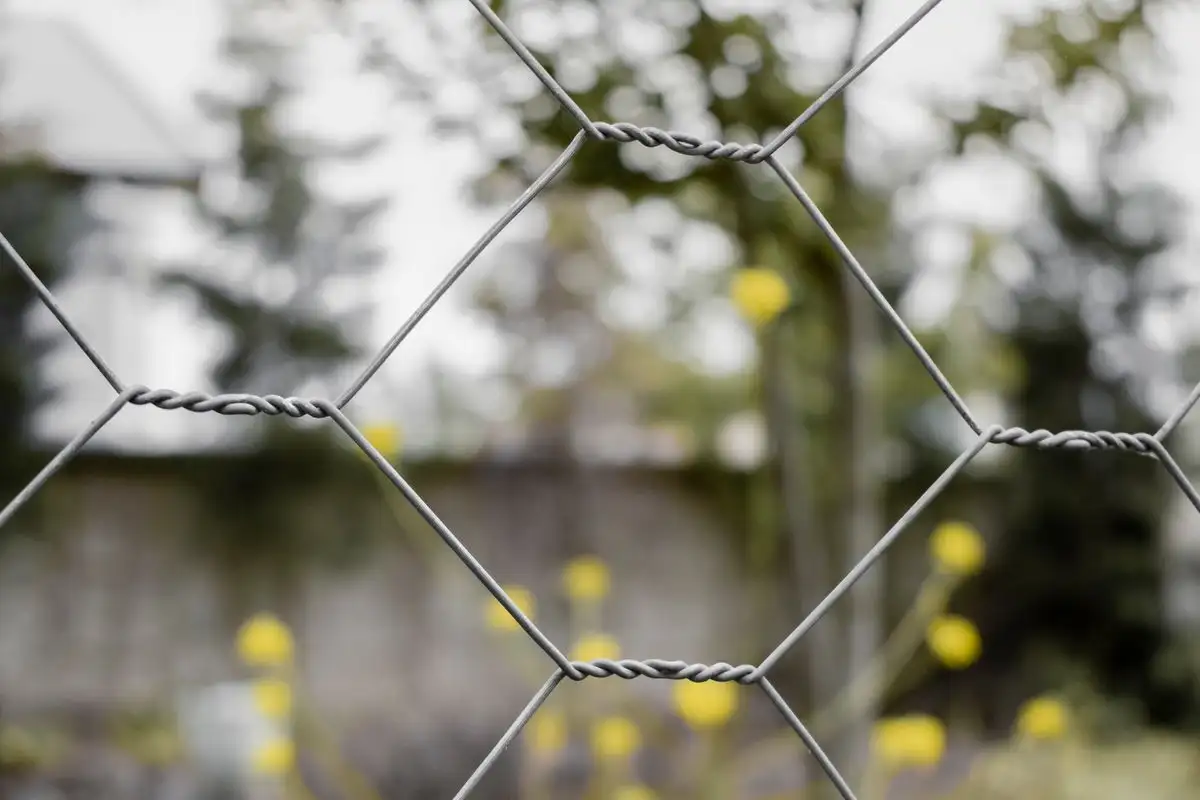
Close the gaps daylight still finds in a hardware cloth job
A hardware cloth job is closed at its geometry, not across its surface. Every place the mesh changes direction or stops — each inside corner, all four sides of a door or gate opening, and every seam where two flat panels meet — is an unfinished joint until it has been lapped, folded, or framed shut. The way to find them is low-angle daylight: walk the finished structure with the sun behind you and close the bright lines it draws.
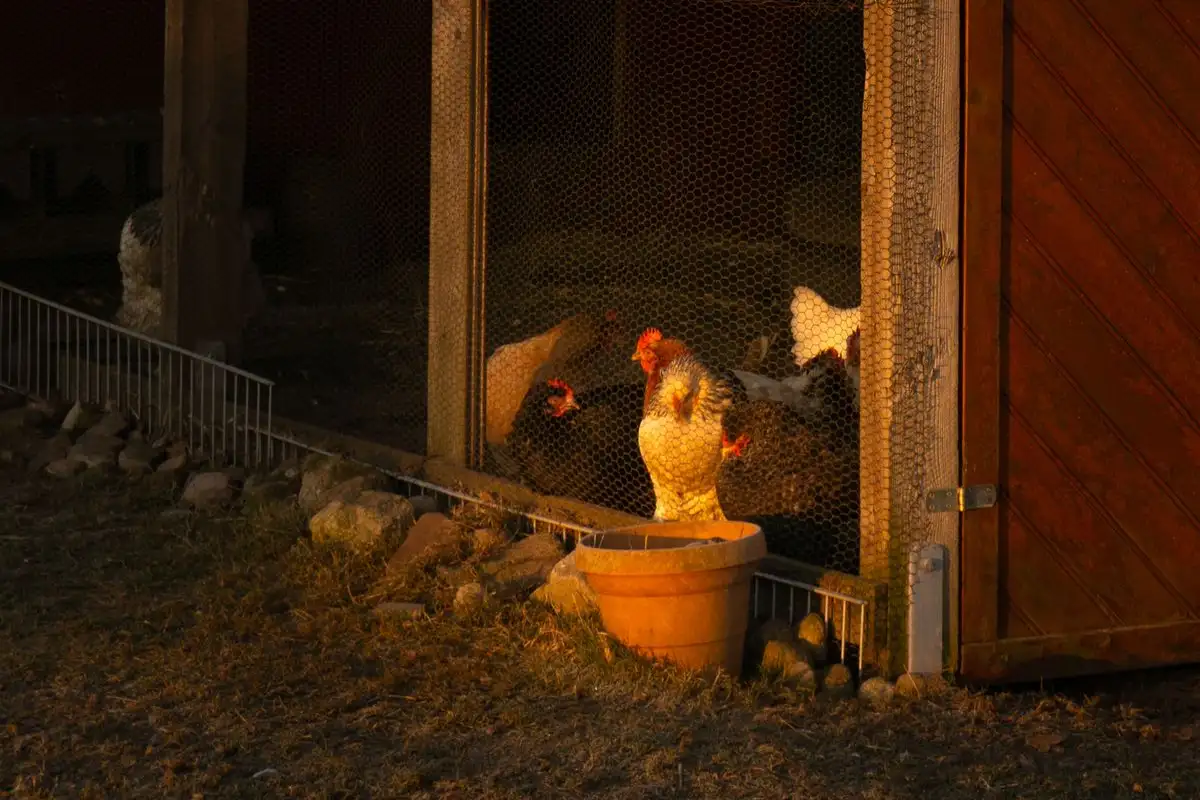
I do that walk in the last hour of the afternoon, standing outside the run, and I don't look at the mesh as a wall. I look at it as one continuous line that starts at the bottom rail, turns up the corner post, breaks at the door, and picks up again on the far side. Wherever the line stops, light gets through. Bright needle at the sill. A thin vertical thread at the corner where two panels meet on a 2x4. A gray smear where the mesh laps but the staples only caught one layer. On an overcast day I hold a flashlight flat against the mesh from the inside and walk the outside — same walk, same lines.
That is the whole method. The rest is knowing what to do at each of the three kinds of transition.
Inside corners
An inside corner is two planes meeting, and the lazy way to build it is two flat panels butted into the corner post, one on each face, each stapled flat to its own side. It looks tight in July. By January the post has moved across the grain, the panels have not, and there is a line at the corner.
What I do instead is fold. One panel wraps around the corner post and comes back a few inches on the adjacent face. The second panel laps over that folded flap and gets fastened through both layers into the post. Now the corner is a continuous wrap of metal instead of a seam between two rigid plates, and the two panels can slide across each other as the wood moves without a gap ever opening.
Two things matter when I fold. Get a fastener within an inch or so of the fold line on both faces, so the fold cannot peel open under a shove. And lap generously — three or four inches, not one. Folded corners eat a little more mesh. On a small coop that is nothing; on a long run it is real footage, and that is the honest tradeoff of doing it this way.
Seams between flat panels
A four-foot roll runs out and the next one starts. That seam is the most common daylight failure I find, and it is almost always because the two panels were butted edge to edge and stapled side by side into the same girt.
Panels are rigid in their own plane. A butt joint between two rigid panels pinned to the same member has nothing to absorb movement, so any change in the wood shows up as an open line. Overlap instead. Carry the second panel two or three inches over the first, across a framing member — a post, a girt, a bottom rail — and fasten both layers into that member. The framing is the thing both panels agree on. Space fasteners every couple of inches along the overlap and stagger them top and bottom so you are not driving two staples into the same grain line and splitting it.
Where two panel edges simply cannot reach framing, a clip or a wire ring joining mesh to mesh will keep them from flapping, but it will not close the seam the way a lap over framing does, because mesh-to-mesh has no stiffness to pull against. I treat those as temporary until I can get a rail behind them.
Door and gate openings
A doorway is a hole, and mesh spanning a hole has nothing to pull against. The opening needs framing on all four sides — header, both jambs, and a sill — with the mesh fastened to all four, not just to the top and bottom rails. Mesh fastened only top and bottom will oil-can in the middle of the jamb; you can push it with two fingers and watch it flex away from the frame.
The leaf of the gate is the piece people finish worst. Mesh stapled flat to the outside face of the frame and cut off at the edges leaves a raw edge at the top and bottom of the leaf, and an exposed cut edge is an edge that can be bent back. I wrap the leaf the same way I wrap a corner. The mesh goes around the frame member, past the edge, and gets fastened on the inside face.
The two gaps that defeat the mesh
Mesh size sets the threshold. Half-inch cloth means nothing wider than half an inch gets through, and a half-inch gap under a door sill is exactly as open as one square of the mesh. That is the standard I hold a door to, and it is the standard I would hold any perimeter to.
It fails in two places. Under the sill: the bottom of the leaf rides above the ground, and if you leave it there, the sill is an opening the full width of the door. A sill board under the leaf, with the mesh on the leaf running a little past the bottom edge so it overlaps that board when the gate swings closed, closes it. On the hinge side: the gap appears behind the hinge because the jamb sits back from the plane of the leaf. That is a frame geometry problem, not a hinge problem. The jamb framing has to come out flush enough that the leaf closes against it instead of beside it.
Where the mesh ends
The rule I use is simple: never let mesh end in open air. Wrap it just past the corner, around the post or the rail, and fasten it on the adjacent face. The cut edge ends up on the inside face, backed by wood. The load goes into the fold rather than into the fasteners, and there is no free corner for anything to work at.
That applies at the top of a wall too. Where the mesh meets the roofline or a top plate, fold it over the member and staple on the far side rather than trimming it flush with the outside face. Same at the ground: the bottom edge of the mesh should turn out and be fastened down along its length, not cut off below grade or left hanging, because an unfastened bottom edge is the same unfinished edge as any other.
Walking it again
Order of work matters as much as the joints. I do corners first, then openings, then the long flat seams, because the corners set the plane that everything else lines up to. If I run the flat panels first and come back to the corners, I end up fighting the mesh the whole way.
And I walk the finished structure again a week later in the same low light. The places that come back are almost always the ones I butted instead of lapped, or the ones where a fastener only caught one layer. Daylight is patient. It finds the same joints every time.