What Breed Genetics Decide About Your Eggs Before You Buy
Three things in the egg carton are decided by the hen's genetics long before she hatches: the color of the shell, the size of the egg, and how many eggs she will lay in a year. Those are three separate inherited packages, and selecting a breed to win one of them always moves the other two. The blue-shell trait in particular does not behave like brown, and that single difference explains most of what surprises new keepers at the nesting box.
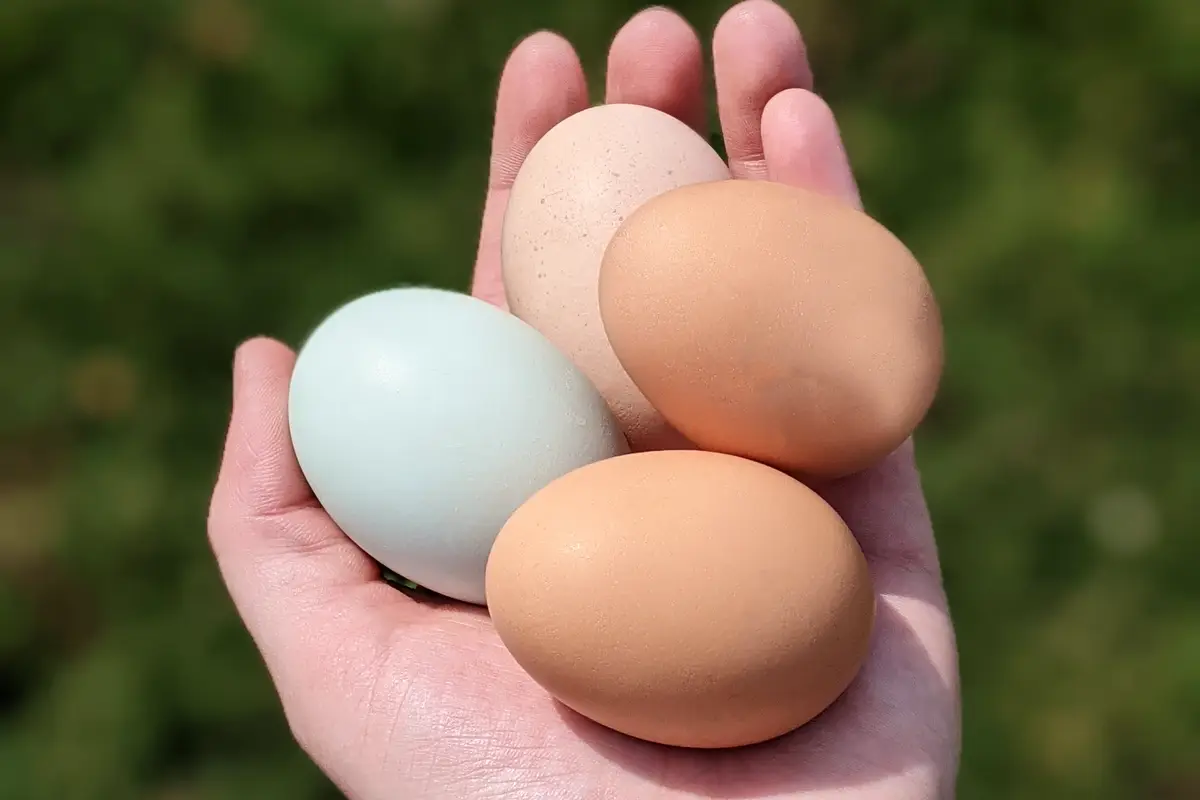
I learned more about shell color from a sink full of spent eggshells than from any chart. Crack a brown egg and turn the shell half over: the inside face is chalky white. The brown was laid onto the outside of the shell as the egg traveled through the hen's shell gland, a thin veneer over a white foundation. Crack a blue egg and the inside face is blue too, all the way through the material. Nothing was painted on.
That is the whole reason blue breeds differently than brown. Brown is a dial. Blue is a switch.
A dial and a switch
Brown shell color comes from protoporphyrin, and it is controlled by many genes that each add a little pigment. That is why brown runs a continuous range, from the pale cream of a Leghorn's egg to the deep copper of a good Marans, and why a hatchery cannot promise you a shade, only a neighborhood. Cross a dark brown layer with a pale one and the chicks land all over that range. Nobody gets a copy of the parent's color.
Blue is a different mechanism entirely. It comes from a single gene with a very large effect, deposited through the thickness of the shell rather than on top of it. One copy is enough, which makes it behave almost like a switch. Breed a blue-egg rooster to almost any hen and the daughters lay blue or green. Green, by the way, is not a third pigment. It is a blue shell with brown pigment laid over it, which is why Olive Eggers exist and why the color math in a mixed pen is far more predictable than it looks.
Two hens, same breed, two different shades
Brown being polygenic is also the answer to the question I get over the fence: why two Buff Orpingtons lay eggs that are visibly different from each other. Same breed, same feed, same coop, slightly different eggs. Nothing is wrong with either bird. Brown is an additive trait, so full sisters can inherit different combinations from the same parents and end up a shade or two apart.
That variation has a practical use. Once I stopped sorting eggs by breed and started sorting them by hen, I could tell who was laying without catching anybody. One hen's eggs ran slightly longer. Another had a fine speckle pattern that never changed. A third laid a shade lighter than her sister. Every hen has a signature, and the signature is hers for life. Her color does not drift the way people expect it to, though the depth of it can breathe a little depending on where she is in a laying cycle.
What a scale tells you before the catalog does
Egg size by breed class is the part you can actually put numbers on. Put a bantam egg on a kitchen scale and it comes in around 1.2 to 1.5 ounces. Light breeds like Leghorns and Anconas run roughly 2 to 2.4 ounces. The dual-purpose middle, Orpingtons, Wyandottes, Australorps, sits around 2.3 to 2.6. The heavy end, Brahmas, Delawares, Jersey Giants, pushes past 3 ounces on a good hen.
Filling a dozen is where that stops being trivia. A dozen bantam eggs weighs somewhere around a pound and change. A dozen from heavy hens can run close to two pounds. The carton looks identical from the outside. Pick it up and the difference is obvious, which matters if you sell, share, or cook for people who are used to supermarket eggs.
People who keep bantams figure this out fast and usually decide they don't care, because bantams eat a fraction of what a Jersey Giant eats and take up a fraction of the space. That trade is honest, as long as you go into it knowing the eggs are small and that many bantam hens go broody at the drop of a hat.
Big eggs cost you eggs
This is the part the catalogs leave in small print. The breeds known for unusually large eggs are mostly large-bodied birds, and large-bodied birds lay fewer eggs per year. A Jersey Giant hen that throws a three-ounce egg is not going to hand you three hundred of them. Production Leghorns and sex-link hybrids hit the high numbers, and their eggs are large for their body size, but those bodies are built for output rather than for longevity.
The breeds with the deepest, most decorative eggs tend to be the most modest layers. Welsummers and Marans, which people choose precisely for shell color, usually land in the 150 to 200 eggs a year range. The biggest, most reliable producers are the plain ones.
There are two hidden costs in ordering for size. The first is feed and space: heavier hens eat more and want more room on the roost. The second is that a young pullet laying a very large egg is at risk of an oversized egg she struggles to pass, which is worth watching in the first weeks of lay. The same young, high-producing pullets are also the ones most likely to throw double yolks, which is a novelty until it isn't.
Heritage dual-purpose brown layers carry a cost of their own that has nothing to do with the egg: broodiness. A hen who decides to set stops laying for three weeks or more and takes the best nest box with her. If a full carton every day is the goal, that trait will cost you more eggs than any color decision ever will.
Color is fixed, size is not
A hen's shell color is set by her genetics and stays hers. Her egg size is not fixed at all, and this trips people up when they judge a breed off their first month of eggs.
Egg size climbs through her first laying year, plateaus, and by her second and third year she is laying fewer eggs that are larger and thinner-shelled. Old hens lay big eggs. That is the trade for the count dropping off.
Season moves it too. A hen in a hard molt stops, then restarts with small eggs that grow back into her normal range as the cycle progresses. In a stretch of real heat, intake drops and the eggs shrink a little along with it. I've had the same hen give me a small egg in July and a noticeably larger one from the same body in October.
Shell thickness is its own inherited trait, separate from color. A dark chocolate Marans egg is not automatically a hard egg, and a white Leghorn egg is not automatically a fragile one. Thickness is also affected by how old the hen is and by whether she is getting enough calcium and vitamin D to build a good shell. Two hens, same color, different thickness is completely normal.
What to actually ask before you order
The egg color line in a hatchery catalog is the most trustworthy claim on the page, especially for blue and green, because that trait is simple. Egg size and annual production numbers are line averages under good management, not promises about your coop in February, so treat them as the shape of the bird rather than a specification.
Ask whether the stock is a production line or a show line. They diverge enormously. A show-bred Orpington and a production Orpington are the same breed on paper and very different birds in the nest box.
If you plan to hatch your own replacements, buy pure breeds. Sex-link hybrids and most production brown-egg layers are the egg equivalent of a shortcut: predictable eggs, but the pullets will not reproduce the bird you bought. You are buying the egg, not the genetics. Easter Eggers are a category rather than a breed, so blue and green eggs are a draw from a hat. Ameraucanas and Cream Legbars are the standardized blue layers if you want the color to repeat in the next generation.
And treat the first two months of pullet eggs as a rough draft. Small, sometimes oddly shaped, occasionally soft. Shape itself is a low-stakes trait, fairly consistent per hen but not worth selecting on. It tells you more about her plumbing than about her genetics.
The hen pays for everything out of one energy budget. Shell pigment, egg bulk, body heat, feathers, all of it comes from the same account, so a breed that is extravagant in one column is usually frugal in another. Decide which column you can live without, then pick the color you like on top. That order of operations is what keeps you from being disappointed by a beautiful hen who lays 140 eggs and quits for the winter.