Which Chicken Breeds Lay Blue Eggs, and Why Green Shows Up in the Cross
Blue eggshells trace back to one line of birds: the Araucana, and everything bred up from it. Ameraucana, Cream Legbar, Whiting True Blue, and the loose hatchery category sold as Easter Egger all carry the same dominant blue-egg gene. Dominance is the part most people miss. Cross a blue-laying hen with a brown-laying hen and nothing blends into a dull tan. The shell comes out green, because blue is the shell itself and brown is a separate pigment applied over the outside of it. Where those two layers sit on top of each other, the eye reads green.
The basket tells you the breed before you see the bird
I keep a mixed flock of nine or ten, and the egg basket has become the fastest way I know to tell who laid what without picking anybody up. January, around six in the morning, about twenty degrees, and I'm crouched in front of the nest box with a headlamp because the coop light burned out three weeks ago and I still haven't fixed it. In that light you sort by feel. The Marans egg has weight to it, a density that reads almost like a river stone. The Leghorn egg is long and pointed and feels like it might break if you handle it wrong. The blue eggs out of the Ameraucana feel like ordinary eggs and give you nothing at all, which is its own kind of clue.
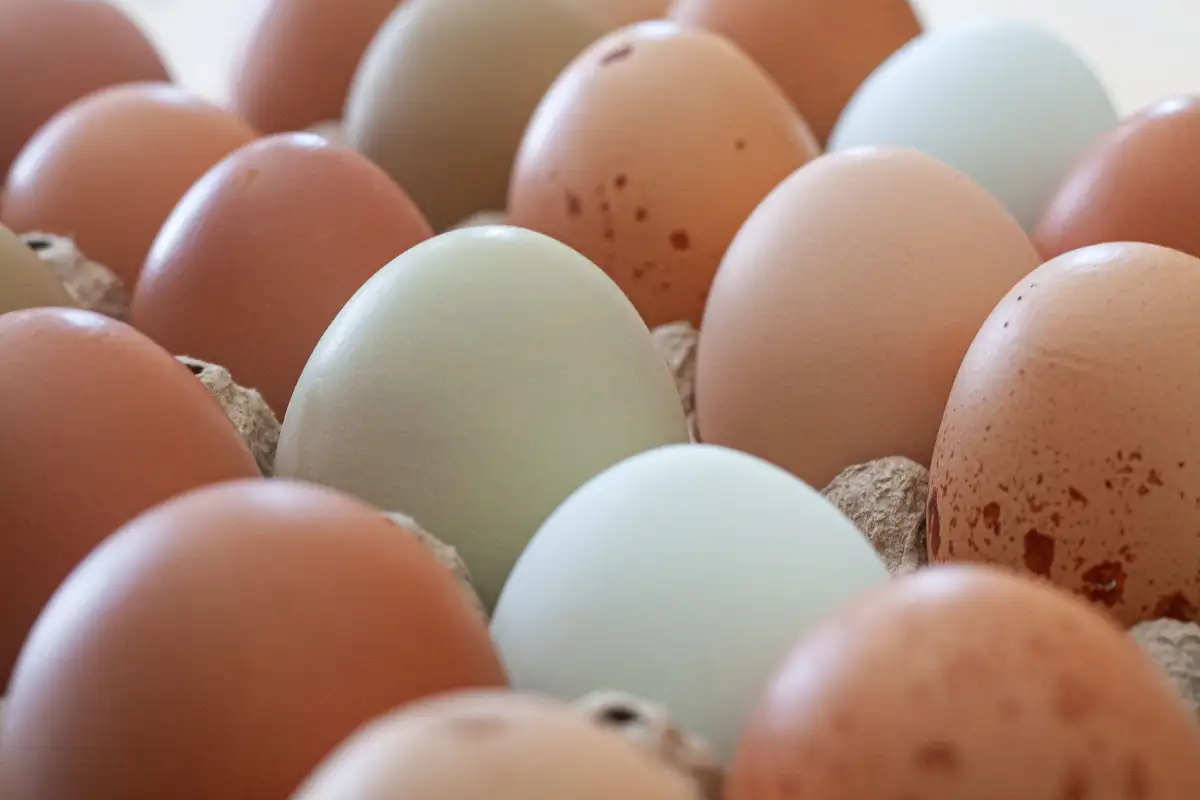
Then I bring them inside and lay them on the windowsill, where the light comes flat off the snow, and there's the whole lesson in one row. Chalk white. A warm medium brown. Chocolate so dark it's nearly the color of wet bark. Powder blue. One sage green with faint darker speckling across the wide end.
I didn't build that row by buying four of the same breed. I built it by buying four different ones. More on that in a minute.
What's actually happening inside the shell gland
Shell color is a breed trait the same way comb shape or tail angle is. It's fixed by the bird's genetics, not by feed, not by daylight, not by how she's feeling that week. The pigment gets deposited near the very end of the twenty-some hours an egg spends forming, in the shell gland. That timing is why one hen's shade can drift a little across a season even though her DNA hasn't changed.
The two pigments don't work the same way, and that difference explains almost everything else.
Brown is protoporphyrin, and a hen lays it down late, as a coating on the outside of a shell that's already finished. It's a surface treatment. Scratch through it and you find pale shell underneath.
Blue is biliverdin, and it's built into the shell as the shell forms, all the way through the thickness. It isn't paint. It's material.
You can test both of these in about four seconds on your own counter. Tap a blue egg open and look at the broken edge. The cross-section is blue through the whole wall, and the inside face is the same blue as the outside. Do the same with a brown egg from a Rhode Island Red and the broken edge is pale, almost white, with a thin brown skin on the outer face only. That inner surface of a brown egg is where the truth is. The brown never got in.
A green egg is just both of those things at once. Blue wall, brown coat over it. Break one open and the edge is blue while the outside is green, which looks like a contradiction until you remember you're looking at two separate structures.
Why the cross doesn't muddy
The blue-egg gene is autosomal dominant. Not a sex-linked trait, so it won't help you sort pullets from cockerels, in case anyone ever tells you otherwise. Dominant means one copy is enough. A hen needs a single blue allele to lay a blue shell, and that means a cross between a blue layer and a brown layer gives you daughters that all lay blue-based shells.
But the brown parent keeps contributing its own pigment on top. So:
Blue shell under a light brown coating gives you a pale, minty, sea-glass green.
Blue shell under a heavy dark brown coating gives you olive, khaki, the color of a good pickle.
This is what people mean by an Olive Egger. It isn't a breed in the formal sense, and it isn't a color you can buy reliably by name. It's a cross, usually a blue-gene bird over a Marans or a Welsummer, and the depth of the green depends entirely on how dark the brown side runs. Buy the same Olive Egger from two hatcheries and you may get two different greens, or one green and one blue, because the brown half of the equation was never specified.
The same caution applies to Easter Eggers. That word describes genetics, not a breed standard. A hatchery Easter Egger is any bird carrying the blue gene in mixed plumage, and she may lay blue, or green, or a greenish khaki that isn't quite either one. If you want a predictable shade, buy a named breed that lays it, or plan on hatching your own second generation and keeping the pullets that do what you want.
Same hen, October and then March
Here's the part that surprises people who expect a hen to be a printing press. She isn't. The shade drifts.
The first eggs from a pullet are small, sometimes absurdly small, and the pigment on them looks almost exaggerated, because the same amount of color is going onto a much smaller surface. Then she grows into her frame. By her second and third year she's laying larger eggs than she ever did as a pullet, and those bigger shells are often a touch paler, because the pigment budget didn't grow along with the egg.
Brown layers show this dramatically. Marans and Welsummer hens lay their darkest eggs at the start of a laying cycle. As the cycle runs on, week after week of the same hen pushing out an egg nearly every day, the brown thins out, and by late summer a Marans egg that was chocolate in March can be a fairly ordinary brown. Then she molts, takes a few weeks off, and starts again in the fall. That first egg after the molt is usually as dark as anything she laid in the spring, sometimes darker. I've had a hen go from near-black in October to milk chocolate in August and back again, and none of it had anything to do with her breed, her feed, or anything I did.
Blue layers drift too, but it's less obvious, because the blue is inside the shell rather than sitting on it. There's no coat to wear thin. What you see instead is a slow shift in saturation, a bright turquoise pullet egg turning a softer, more powdery blue by year three. Subtle enough that you'll only catch it if you've got an old shell around to hold next to the new one. Which, fair warning, is how the windowsill gets crowded.
Shape and texture run on breed lines too
Color gets all the attention, but shape and texture are just as legible once you've handled a few hundred eggs. Leghorns and their kin lay long, pointed, almost torpedo-shaped eggs. Orpingtons lay round, smooth ones that sit flat in the hand. Marans are known for round eggs with notably thick, hard shells, and you can feel that difference when you close your fingers around one. Welsummers run slightly pointed and often carry dark speckles across the wide end.
So a shell in the basket can sometimes tell you who laid it even when the color is ambiguous. A green egg that's long and pointed and thin-shelled came from a different bird than a green egg that's round and heavy and speckled, and you know that before you ever look at the hen.
Four birds will give you four unmistakable shades
If what you want is a basket that reads like a color chart, and it's a reasonable thing to want, the reliable approach is one bird per pigment rather than four birds of one breed.
One white layer. A Leghorn is the classic, and there are others.
One standard brown layer. A sex-link, a Rhode Island Red, a Barred Rock.
One dark brown layer. A Marans or a Welsummer, and expect the color to soften as the season runs.
One blue layer. An Ameraucana or a Cream Legbar if you want a named breed with a predictable shell.
Four birds, four shades nobody has to squint at. Greens require a second generation, either hatched yourself or bought as a bird that already carries both pigments, and you accept that the specific green is whatever she decides it is. That's the honest tradeoff. Predictability costs you a breed purchase; variety costs you predictability. There's no way to buy your way out of choosing.
The other thing I'd tell anyone starting down this road is to save the empty shells from each pullet's first few eggs and write the bird's name on them. Because in two years, after the drift and two molts, you will absolutely not remember what that Marans egg looked like in her first October. Having a shelf of old shells to hold a new one against is how you find out that the breed was never the thing that changed.