The Coop Design Flaw That Lets Predators In Every Night
The single design vulnerability that turns a chicken coop into a nightly access point is a latch a determined predator defeats in under ten seconds. After that initial breach, the entire structure undergoes a methodical scan: the gap under the floor, the overhang above the roofline, the ventilation cover that looked secure in daytime, and every joint held with little more than a staple. Most coop losses don’t trace back to a flimsy build—they trace back to a layout that handed the predator a logical sequence of weak points. The keeper’s job is to understand that sequence and block it, not just reinforce the door and move on.
The Four Breach Zones a Predator Tests First
A predator doesn’t evaluate a coop as a finished picture. It reads edges, seams, and openings like an access logic diagram. The same four zones get checked every night: the latch and door assembly, the floor and dig barrier, the roof and ventilation openings, and the structural joints that connect everything. Each zone answers a different entry tactic. If any one of them is left unaddressed, the coop’s overall defense collapses because the predator simply moves laterally to the next soft spot. The design flaw isn’t just the latch—it’s the absence of a zone-based audit.
The Coop Breach Audit: Hardening the Structure by Zone
Zone 1: The Latch and Door – Why a Hook-and-Eye Fails Under Pressure
A hook-and-eye latch rests closed as long as nothing tries to open it. A raccoon grips the eye, twists, and lifts in a single fluid motion. A gravity latch—the pin that drops into a receiver—slides upward just as easily. Even a padlock left hanging on an open hasp is purely cosmetic. The door assembly must be evaluated by assuming the animal has hands, patience, and enough problem-solving drive to work a simple mechanism.
Replace any latch that opens with one unimpeded motion. A two-step latch requiring a squeeze-and-lift sequence, or a carabiner that demands a thumb-like action, raises the skill floor beyond a raccoon’s routine ability. Secure the hasp with a closed carabiner or a padlock that locks. Measure the door gap: a quarter-inch clearance lets a weasel slip through and provides leverage for a raccoon to insert its paw and pry. Exterior hinges act as grab points; cap them or use pinned, non-removable hinges screwed through the jamb into solid blocking.
Done well, the door becomes an asymmetric barrier. The keeper opens it quickly; the predator encounters a sequence it cannot reverse.
Zone 2: Floor Elevation and the Dig Barrier – Denying the Tunnel Attack
A coop sitting directly on the ground places the flock on top of an unguarded tunnel. Foxes, dogs, and raccoons excavate under the wall in a single night if the soil offers no resistance. An elevated design without a floor underneath trades one weakness for another: rats and weasels climb the legs, and larger predators simply dig a depression and wait for a bird to drop through the open bottom.
The countermeasure is a floor assembly that works from both directions. Raise the floor 12 to 18 inches—this denies a raccoon the reach to pull a bird through the floor and makes digging underneath a deeper, less rewarding effort. Attach a 24-inch-wide hardware cloth apron (1/2-inch mesh) to the perimeter, bent 90 degrees outward and buried 6 to 12 inches deep. The apron converts a vertical digging path into a horizontal puzzle the animal abandons. For a coop that must sit on grade, pour a concrete rat wall around the perimeter or lay pavers over hardware cloth extending under the floor.
Done well, the floor zone eliminates the soft-soil path. The coop reads as a sealed box no matter how determined the digging.
Zone 3: Roof Overhangs and Ventilation – The Overhead Breach Most Owners Miss
A ventilation opening near the roofline is typically the first place a predator tests after the door and ground. A raccoon climbs the wall, grabs the edge of an overhang, and pries up shingles or pulls loose trim. A mink finds a half-inch gap between roof panel and wall plate and slips through. Chicken wire stapled over a vent offers no defense—it tears under a few pounds of sustained pulling force.
Treat the entire overhead layer as a screened defense zone. Every opening—soffit vents, gable vents, and gaps under corrugated roofing—gets a cover of 1/2-inch welded hardware cloth. Secure the hardware cloth with screws and fender washers every three to four inches; staples pull out over time under the weight and leverage of a climbing animal. Trim back overhangs that extend more than a couple of inches beyond the wall, or install a continuous predator guard—a strip of hardware cloth or sheet metal—along the underside to prevent gripping. Check the roof-to-wall junction: if a pencil passes through, a weasel passes through.
Done well, the roof and ventilation zone presents a smooth, uniformly screened surface from eaves to peak. No grip points, no gaps, no weak screening a climber can exploit.
Zone 4: Structural Joints and Hardware – Where Cheap Fasteners Fail
A coop assembled with staples, finishing nails, and lightweight hinges holds its shape under no load. Introduce prying force—a raccoon working a corner seam or a dog throwing its weight against the door—and those fasteners become the primary failure point. Staples tear along the grain. Nails back out under repeated temperature swings, leaving gaps. Hinges with loose pins lift off with minimal effort.
This zone audit requires swapping every fastener that served only assembly for components that also serve defense. Use 1-1/2-inch deck screws for framing connections and 3/4-inch screws for hardware cloth attachment. Add corner braces inside and out at wall junctions. Install heavy-duty, non-removable-pin hinges on any door wider than a nest box. Where wire mesh meets wood, sandwich it between a batten strip and the frame with screws, not staples. Push against every joint: if the wood moves or the gap opens, reinforce it before a predator performs the same test in the dark.
Done well, the structure behaves as a single rigid unit. There’s no seam a tooth or claw can work into, and no fastener that loosens under sustained force.
Auditing a Typical Prefab Coop: One Realistic Run-Through
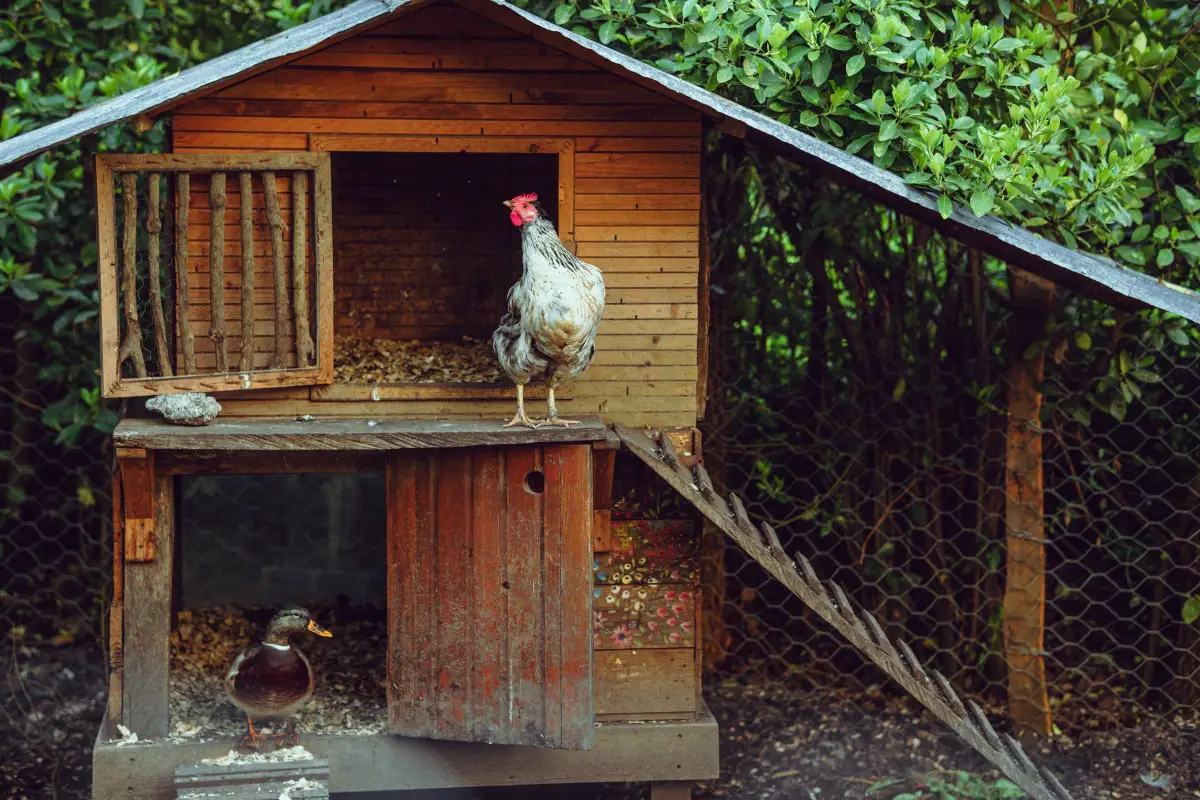
Take a standard flat-pack backyard coop: a wooden box on short legs, a single gravity-latch door, an open-bottomed run space, and a few vent openings under the eaves covered with chicken wire.
The zone audit reveals four immediate failures. The gravity latch lifts with one upward tug—swap it for a spring-loaded gate latch and carabiner. The legs sit directly on soil with no apron; a predator digs under the wall in minutes—install an outward hardware cloth apron around the entire perimeter, burying the horizontal leg six inches deep. The chicken wire over the eave vents separates with a firm pull—remove it and screw on 1/2-inch hardware cloth with fender washers at three-inch spacing. The door hinges are two-inch utility hinges secured with half-inch staples—replace them with heavy-duty T-hinges driven into blocking with deck screws.
One afternoon’s work converts the same coop from a nightly risk to a sealed defensive system. The failures weren’t exotic. They were standard construction shortcuts that a predator’s methodical search exploited without difficulty.
Where Keepers Break the Coop Audit
Trusting a Gravity Latch That Requires No Understanding to Defeat
The most common and costly assumption: any latch will do. Gravity latches, hook-and-eyes, and barrel bolts all assume the animal lacks dexterity. Raccoons have that dexterity. The result is a door standing open by dawn and an empty roost.
Using Chicken Wire as a Protective Barrier
Chicken wire contains chickens. It stops no predator. A dog chews through it, a raccoon tears it apart, and a weasel passes straight through the hexagonal gaps. Replacing hardware cloth with chicken wire on vents, windows, or run walls creates the sensation of security without producing any.
Ignoring the Floor Because the Predator Is Supposedly Ground-Excluded
Coops on solid floors set on grade often escape scrutiny because owners assume digging threats apply only to open runs. A rat tunnels under the wall and gnaws through floor plywood in days. A soft-soil perimeter around a ground-level coop is an undefended entrance ramp. Until a floor apron or buried barrier is in place, the coop remains accessible from below.
Quick Reference: The Coop Breach Audit at a Glance
| Zone | Goal | Key Action |
|---|---|---|
| Latch & Door | Prevent manipulation and forced entry | Install a two-step latch or padlock; check door gaps under ¼ inch |
| Floor & Dig Barrier | Stop tunneling predators | Elevate 12–18 inches; bury a 24-inch hardware cloth apron |
| Roof & Ventilation | Eliminate climbing and squeezing entry | Cover all openings with 1/2-inch hardware cloth screwed with washers |
| Joints & Fasteners | Prevent prying and structural failure | Use screws instead of nails; add braces; upgrade hinges |
Frequently Asked Questions
Can I use a bungee cord instead of a proper latch?
No. A bungee cord stretches, and a raccoon hooks it with a claw to release the tension in one motion. It provides no resistance to a deliberate opening attempt.
Does hardware cloth really need to go underground?
Yes. The outward-facing apron forces the animal to encounter wire before reaching the wall. Without a horizontal barrier buried alongside the foundation, a predator digs directly down next to the wall and gains access in minutes.
How high above the ground is high enough?
Twelve inches serves as a functional minimum for small to medium breeds. In areas with dense fox populations or for larger coops, 18 inches provides a better buffer and discourages raccoons from reaching up through the floor.
Can I just use chicken wire for the roof vent if I double it up?
No. Two layers of chicken wire share the same tensile limitation as one. Predator-resistant screening requires welded hardware cloth; doubling does not increase material strength.
Are padlocks really necessary if I’m in and out for egg collection?
Not if the latch itself is a two-step design requiring simultaneous motions. On coops in high-pressure predator areas, a padlock eliminates any chance of a dexterous animal working the mechanism. Use a combination lock for quick access—convenience influences compliance, but an unlocked lock is not a defense.
Stop the Nightly Breach Before It Becomes a Pattern
The Coop Breach Audit compresses a predator’s overnight scan into four checkpoints: latch, floor, overhead, and joints. Each zone answers a specific attack—manipulation, digging, climbing, prying—and each fails the moment it’s taken for granted. Start with the latch tonight. A carabiner and a screwdriver close the most common entry point. Once the door holds, address the floor and roof, then tighten every fastener on the structure. A predator finding no easy path tonight will return, but each failed attempt buys another night until the audit is complete.