What a Poultry Specialist Checks in Homemade Layer Feed
When a homemade layer ration causes a drop in lay rate, the cause is rarely a total protein shortage. The first limiting amino acid in corn-based poultry diets—lysine—gets diluted below the physiological threshold, and egg synthesis stalls. A ration that looks adequate by crude protein alone can fail; fix the lysine ratio and production typically rebounds in 10–14 days.
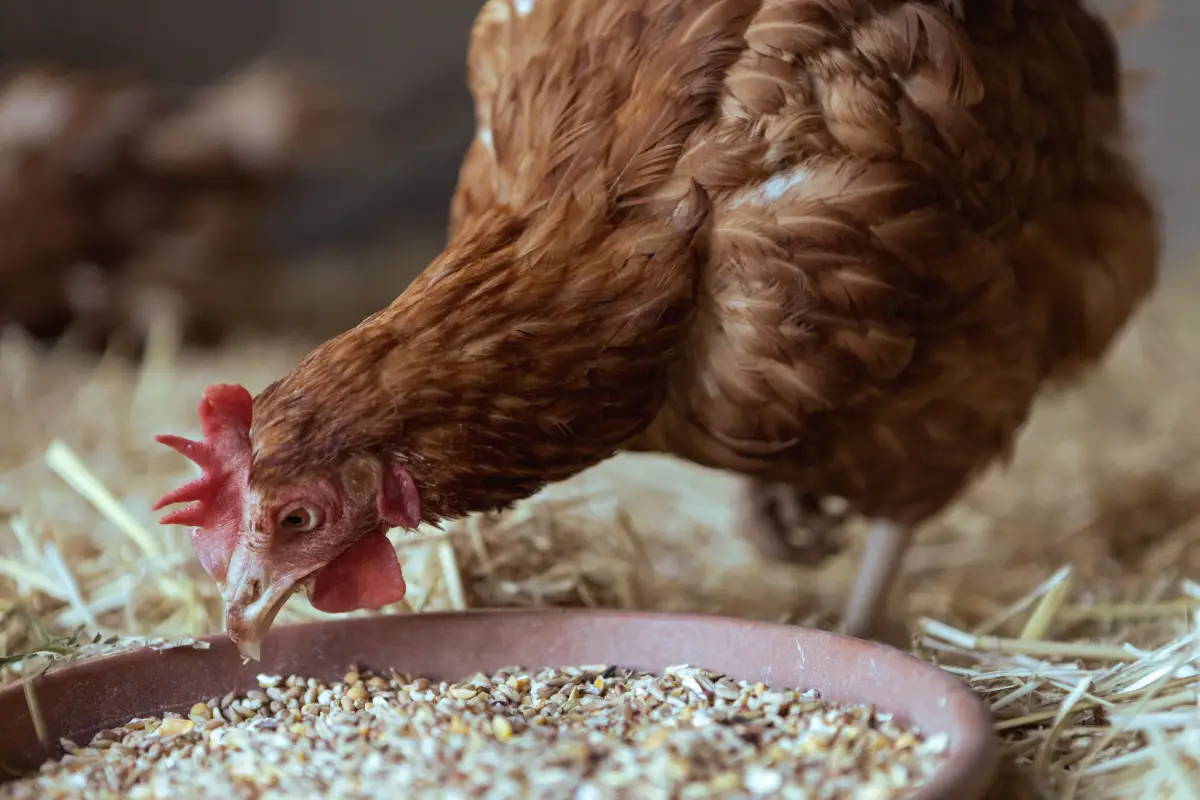
Homemade layer feed is best understood as a dilution problem. A high-energy base grain (usually corn) provides calories but almost no lysine. A protein concentrate is added to reach a crude protein target, but if that concentrate doesn’t carry enough lysine per unit of energy, the ratio collapses. The pattern is common: a flock of high-output Leghorn hybrids receives a mix of 70% cracked corn, 15% soybean meal, 10% barley, and 5% mineral premix. Crude protein sits at 14.7%, on the low side but not catastrophic. Lysine, however, comes out to 0.64%. Within three weeks, daily egg numbers fall 20%. More soybean meal alone won’t fix it—that just raises total protein while barely nudging lysine because soybean meal itself is only 2.9% lysine. The real correction is to close the lysine gap directly, either with synthetic lysine or a high-lysine ingredient swap.
The 7-Step Lysine Balancing Sequence
- Set a whole-grain base at 60–70% of the mix (corn, wheat, barley, or a blend).
- Select a protein concentrate—soybean meal, canola meal, fish meal, or field peas—to bring crude protein to 16–18%.
- Calculate the ration’s lysine content: (concentrate’s % lysine × inclusion rate) + (base grains’ contributions).
- Determine the lysine gap for your flock: target 0.70–0.85% of diet (lower for older hens, higher for heavy-laying hybrids).
- Bridge the gap with L-lysine HCl (78% lysine) or replace part of the grain with a high-lysine ingredient like fish meal.
- Balance calcium at 3.5–4.0% using limestone or oyster shell, and methionine at 0.35%.
- Mix uniformly, feed a small test group for 7–10 days, and track egg count, shell quality, and feed intake.
Why a High-Corn, Low-Soy Mix Starves Lysine Intake
Corn supplies about 0.24% lysine as fed; soybean meal clocks in at 2.9%. In the 70:15:10:5 example, the blend’s lysine lands at 0.64%. For a broiler that’s tolerable, but for a hen depositing roughly 700 mg of lysine into eggs daily, it’s a chronic deficit. The hen’s response is physiological, not behavioral: she downregulates egg size and frequency before losing body condition. Crude protein alone is a weak proxy; lysine is the metabolic gatekeeper.
The dilution risk is highest at peak production (25–40 weeks). Older hens with declining output can tolerate lysine as low as 0.65% because their daily egg mass is smaller. When feed intake remains normal but egg numbers slip, the first variable a specialist checks is the lysine-to-energy ratio, not disease.
Choosing the Protein Concentrate That Matches Hen Age and Egg Output
The protein concentrate offsets the grain’s weak lysine profile and supplies other amino acids, but the optimum choice shifts with flock stage.
- Peak production (25–40 weeks): Soybean meal (48% protein, 2.9% lysine) is a dependable, cost-effective base. Canola meal (36% protein, 2.0% lysine) can work but forces a higher inclusion rate, which adds fiber and may suppress feed intake.
- Older hens (50+ weeks) with declining output: Field peas (22% protein, 1.6% lysine) or sunflower meal (30% protein, 1.1% lysine) often suffice, since the requirement dips to around 0.65%. Over-supplying lysine at this stage just wastes nitrogen.
- If a high-lysine, low-fiber boost is needed: Fish meal (60% protein, 4.5% lysine) is concentrated. Substituting 2–3% of the grain raises lysine without a large calorie jump.
A diagnostic shortcut: hens that eat well but lay smaller eggs are almost certainly lysine-limited. If they also lose breast muscle, total protein intake is the deeper problem.
Mapping the Exact Lysine Deficit for Your Flock
Lysine targets are specific to genetics and output. A Leghorn hybrid laying 300 eggs per year needs about 0.80% dietary lysine during peak lay. A dual-purpose Orpington at 200 eggs per year functions on 0.65%. Work with these as-fed values:
- Corn: 0.24% lysine
- Wheat: 0.30%
- Barley: 0.35%
- Oats: 0.40%
- Soybean meal (48%): 2.9%
- Canola meal: 2.0%
- Field peas: 1.6%
- Fish meal: 4.5%
- L-lysine HCl: 78%
For the flawed 70:15:10:5 mix, the math runs:
- Corn: 0.70 × 0.24 = 0.168%
- Soybean meal: 0.15 × 2.9 = 0.435%
- Barley: 0.10 × 0.35 = 0.035%
- Total lysine = 0.638%
Against a 0.75% target for hybrids, the gap is 0.11 percentage points, meaning 110 g of lysine per 100 kg of feed. Supplying that via L-lysine HCl (78% lysine) requires 110 ÷ 0.78 = 141 g of powder—roughly 0.14% of the total. Swapping 5% of corn for fish meal adds 0.225% lysine, which overshoots but works if the extra protein and minerals are accounted for.
Two Ways to Bridge the Lysine Gap: Synthetic Supplement or Ingredient Swap
Once the deficit is known, the choice is between precision and ingredient rebalancing.
Option A: L-lysine HCl. A tasteless white powder, 78% lysine. It patches the hole without altering energy or protein. The downside is that it contributes nothing else; some flock owners prefer to avoid synthetic additives. Still, from a formulation standpoint, it’s the cleanest fix.
Option B: Ingredient swap. Increasing soybean meal from 15% to 25% and cutting corn lifts lysine to 0.77% but pushes crude protein past 20%, which is wasteful and taxes the kidneys. Using fish meal (2–3% of the diet) is more lysine-efficient but also adds calcium and phosphorus, so limestone must be backed off. For small flocks, a hybrid approach often works best: boost soybean meal to 18% and add a tiny pinch of lysine powder to close the remaining gap.
The decision hinges on availability and personal preference, but the formulation principle doesn’t change: keep the lysine-to-energy ratio in the target window, and don’t let adjustments break calcium or methionine balance.
Don’t Forget the Two Supporting Players: Calcium and Methionine
Calcium. A layer requires 3.5–4.0% dietary calcium to form shells consistently. In the example mix, limestone at 5% contributes only about 1.9% calcium—less than half the need. A specialist would immediately spot that under-dosing. To reach 3.8% calcium, limestone must be around 9–10% of the mix, replacing grain. Sub-optimal calcium often shows up as thin-shelled eggs or, in severe cases, calcium tetany.
Methionine. The second limiting amino acid in corn-soy diets. A shortfall doesn’t crash lay rate as dramatically as lysine, but it caps egg size and can trigger feather pecking. The target is roughly 0.35% of the diet. Without synthetic methionine, the easiest route is to include a methionine-rich feedstuff like fish meal or sesame, or add 0.05–0.10% DL-methionine. If eggs remain small despite adequate lysine and calcium, methionine is the next variable to check.
Mixing and Palatability: The 10-Day Trial Run
Uniform mixing is non-negotiable. Fine powders like synthetic amino acids and limestone can segregate, creating hot spots of deficiency. A cement mixer or a large tub with a paddle works for small batches. After mixing, feed a trial group—about 10% of the flock—for 7–10 days. Track daily egg counts, weigh a sample of eggs, and examine shells. If production holds or improves, scale up. If it drops, revisit the lysine and calcium figures before adjusting anything else.
What to Monitor After Each Mixing Stage
- Immediately post-mixing: The blend should look uniform. White streaks indicate unmixed supplements.
- Day 1 of feeding: Hens should consume the feed without hesitation. Reluctance suggests a texture problem or off odor from spoiled ingredients.
- Days 3–7: Egg numbers should stabilize or rise. A drop points to a lysine shortfall or calcium crash.
- Days 7–10: Weigh a dozen eggs. Average weight under 55 g for standard layers flags a problem—thin shells = calcium, small eggs with good shells = lysine or methionine.
When the Ration Still Fails: Troubleshooting the Big Three Deficiencies
Lysine Shortfall: Small Eggs, Fewer Eggs
If the hens eat the feed but produce fewer and smaller eggs, lysine is the prime suspect. Recalculate using the ingredient tag’s guaranteed analysis, not generic book values—batch-to-batch variation can be real. If the numbers still say you’re on target, consider reduced amino acid digestibility from excessive fiber or anti-nutrients (raw soybeans, high-tannin sorghum). Switching ingredient batches or adding a 0.10% lysine safety margin usually resolves it.
Calcium Imbalance: Thin Shells or Layer Fatigue
Thin-shelled or shell-less eggs, or hens showing lameness, point to calcium. But simply adding more limestone isn’t always the answer. Check phosphorus balance; a 2:1 Ca:P ratio is ideal. High-phosphorus byproducts like wheat bran or corn distillers grains can block calcium absorption. Reduce those and bump limestone to achieve 3.8% dietary calcium.
Methionine Gap: Eggs That Never Grow
Uniformly small eggs with decent shells suggest methionine is limiting. Add 0.05% DL-methionine or swap 1% of grain for sesame meal. Track egg size for 10 days; a clear uptick confirms the diagnosis.
Common Questions on Lysine and Homemade Feed
Can’t I just use more soybean meal instead of buying synthetic lysine?
It’s possible but inefficient. To lift lysine from 0.64% to 0.75% in 100 kg of feed, you’d add roughly 5 kg of soybean meal and remove 5 kg of corn. Crude protein jumps from 14.7% to around 17.5%, and you’re also over-supplying several amino acids. A 141-gram scoop of lysine powder does the same without any reformulation. Both routes work; the synthetic path is simply more precise.
How can I test lysine without sending a sample to a lab?
No reliable at-home chemical test exists, but a bioassay works: feed the ration to a test group for 10 days. If egg output and size improve over the previous feed, the lysine level is adequate (assuming calcium is also right). If not, increase the lysine supplement in 0.05% increments and observe. It’s a slow feedback loop, but it’s functional when lab access is impossible.
Does free-ranging reduce lysine needs?
Free-ranging provides insects, worms, and greens that contain some lysine, but the contribution is highly variable. In a lush growing season, it might supply 5–10% of the daily requirement; in winter or on sparse range, effectively zero. The conservative approach is to formulate the core ration assuming no contribution from range and treat any boost as a buffer. If hens free-range, you can aim for the lower end of the lysine range (0.70%) but not below.
What if I can’t source synthetic lysine locally?
Online farm supply vendors ship L-lysine HCl in small quantities. If that’s not possible, use fish meal (2–3% of diet) or increase soybean meal while cutting corn, but recalculate to avoid overshooting other nutrients. Sunflower meal and sesame meal offer moderate lysine levels as alternatives.
After the Fix: Confirming the Ratio and What Comes Next
With the lysine-to-energy ratio corrected, egg production stabilizes and egg size recovers. The next logical step is to weigh a random sample of eggs daily for two weeks and compute the running average. If the average still falls short of the breed’s standard, increase dietary lysine by another 0.05% and reassess. After that, the formula is ready to scale up and batch for the season.